
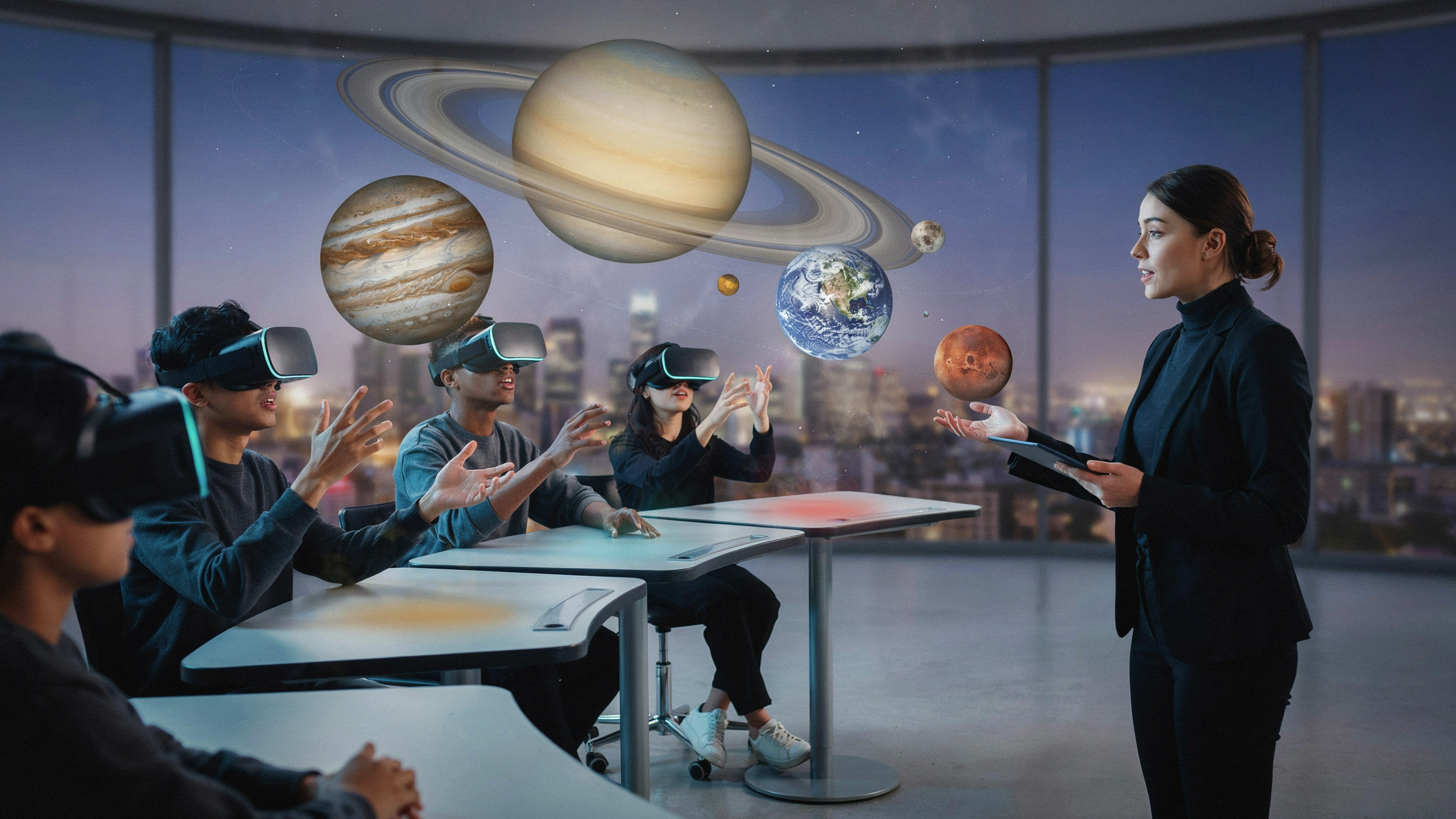
Technology has transformed education in remarkable ways, and one of the most exciting innovations is Virtual Reality (VR). Once associated mainly with video games and entertainment, virtual reality is now becoming a valuable educational tool that helps students experience learning in immersive and interactive ways. By allowing learners to explore environments, conduct virtual experiments, and visit places they could never reach physically, VR is changing how knowledge is delivered and understood.
Virtual reality does not replace traditional teaching. Instead, it enriches classroom instruction by making abstract concepts more concrete, increasing student engagement, and creating memorable learning experiences.
What Is Virtual Reality?
Virtual Reality is a computer-generated, three-dimensional environment that users can explore and interact with using a VR headset and, in many cases, handheld controllers. Unlike watching a video or viewing an image on a screen, VR places students inside a simulated environment where they can look around, move, and interact with virtual objects.
Educational VR experiences can recreate historical events, scientific laboratories, distant planets, underwater ecosystems, famous landmarks, or even microscopic cells inside the human body.
This immersive approach allows students to learn by experiencing rather than simply observing.
Why Virtual Reality Is Valuable in Education
Traditional teaching methods often rely on textbooks, lectures, and static images. While these methods remain important, some concepts are difficult to visualize or understand through text alone.
Virtual Reality helps bridge this gap by allowing students to:
- Explore complex environments.
- Observe scientific processes in action.
- Interact with virtual objects.
- Practice real-world skills safely.
- Experience situations that would otherwise be impossible or too expensive.
Learning becomes more active, engaging, and memorable.
Increasing Student Engagement
Student engagement is one of the biggest factors influencing academic success.
VR captures students’ attention because it transforms passive learning into active participation. Instead of reading about ancient civilizations, students can walk through virtual archaeological sites. Instead of studying the solar system from diagrams, they can travel among the planets.
Immersive experiences stimulate curiosity and encourage students to ask questions, investigate, and think critically.
Many students who struggle with traditional instruction become more motivated when lessons include interactive technologies.
Making Difficult Concepts Easier to Understand
Some academic subjects involve ideas that are difficult to imagine.
Virtual Reality helps students visualize abstract concepts such as:
- Molecular structures in chemistry.
- Human anatomy.
- Space exploration.
- Geological formations.
- Climate change.
- Engineering designs.
- Mathematical geometry.
By interacting with three-dimensional models, students gain a deeper understanding than they might from flat illustrations alone.
Virtual Field Trips
One of the most popular educational uses of VR is the virtual field trip.
Schools often face financial, logistical, or safety limitations that make educational travel difficult. Virtual Reality removes many of these barriers by allowing students to visit locations around the world without leaving the classroom.
Students can explore:
- Ancient Egyptian pyramids.
- The Great Wall of China.
- Rainforests.
- Coral reefs.
- Museums.
- Space stations.
- Volcanoes.
- Polar regions.
These experiences broaden students’ understanding of geography, history, science, and culture.
Enhancing Science Education
Science education benefits greatly from Virtual Reality.
Students can safely perform virtual laboratory experiments that might otherwise require expensive equipment or involve hazardous materials.
Examples include:
- Chemical reactions.
- Human anatomy exploration.
- Physics simulations.
- Ecosystem investigations.
- Astronomy observations.
VR allows learners to repeat experiments multiple times without additional cost or safety risks.
Supporting STEM Learning
Virtual Reality is becoming an important tool for STEM education (Science, Technology, Engineering, and Mathematics).
Students can:
- Build virtual engineering projects.
- Explore robotics systems.
- Design architectural models.
- Practice coding through interactive simulations.
- Solve engineering challenges.
These experiences strengthen problem-solving skills while encouraging creativity and innovation.
Improving Collaboration
Although VR often appears to be an individual experience, many educational platforms now support collaborative virtual environments.
Students can work together inside shared virtual classrooms where they:
- Solve problems.
- Complete science experiments.
- Build projects.
- Participate in discussions.
- Practice teamwork.
Collaborative VR activities help develop communication and leadership skills that are valuable both inside and outside school.
Supporting Students with Different Learning Styles
Every student learns differently.
Virtual Reality supports multiple learning preferences by combining:
- Visual learning through immersive environments.
- Auditory learning through narration and sound.
- Kinesthetic learning through movement and interaction.
- Experiential learning through active participation.
This variety makes lessons more accessible to diverse learners and often improves knowledge retention.
Building Empathy Through Immersive Experiences
One unique advantage of VR is its ability to place students in situations that help them understand different perspectives.
For example, students can experience:
- Life in different cultures.
- Historical events from multiple viewpoints.
- Environmental challenges.
- Humanitarian issues.
- Accessibility challenges faced by people with disabilities.
These experiences encourage empathy, cultural awareness, and global citizenship.
Challenges of Using Virtual Reality in Schools
Despite its many advantages, VR also presents several challenges.
Equipment Costs
High-quality VR headsets, computers, and educational software can be expensive, making implementation difficult for some schools.
Teacher Training
Teachers need professional development to integrate VR effectively into lesson plans and classroom instruction.
Motion Sickness
Some users experience dizziness or discomfort during extended VR sessions. Schools should provide breaks and choose age-appropriate experiences.
Limited Content
Although educational VR resources are expanding rapidly, not every curriculum topic currently has high-quality VR materials available.
Accessibility
Students with certain physical or visual impairments may require alternative learning options or specialized equipment.
Best Practices for Using Virtual Reality
To maximize educational benefits, schools should:
- Align VR activities with learning objectives.
- Use VR as a supplement rather than a replacement for teaching.
- Prepare students before virtual experiences.
- Encourage reflection and discussion afterward.
- Limit session lengths to reduce fatigue.
- Ensure equipment is cleaned and maintained regularly.
Effective planning ensures that technology enhances learning instead of becoming a distraction.
The Future of Virtual Reality in Education
Virtual Reality continues to evolve rapidly.
Future educational developments may include:
- AI-powered virtual tutors.
- Highly realistic science simulations.
- Global collaborative virtual classrooms.
- Career training simulations.
- Virtual internships.
- Personalized immersive learning environments.
As equipment becomes more affordable and educational software expands, VR is expected to become increasingly common in schools around the world.
Conclusion
Virtual Reality is transforming education by bringing lessons to life in ways that traditional teaching methods cannot always achieve. Through immersive experiences, students can explore distant places, conduct safe scientific experiments, visualize complex concepts, and develop essential skills for the future.
Although challenges such as cost, accessibility, and teacher training remain, the educational potential of VR is enormous. When thoughtfully integrated into classroom instruction, Virtual Reality creates engaging, memorable, and meaningful learning experiences that inspire curiosity and deepen understanding. As technology continues to advance, VR will play an increasingly important role in shaping the classrooms of tomorrow.