
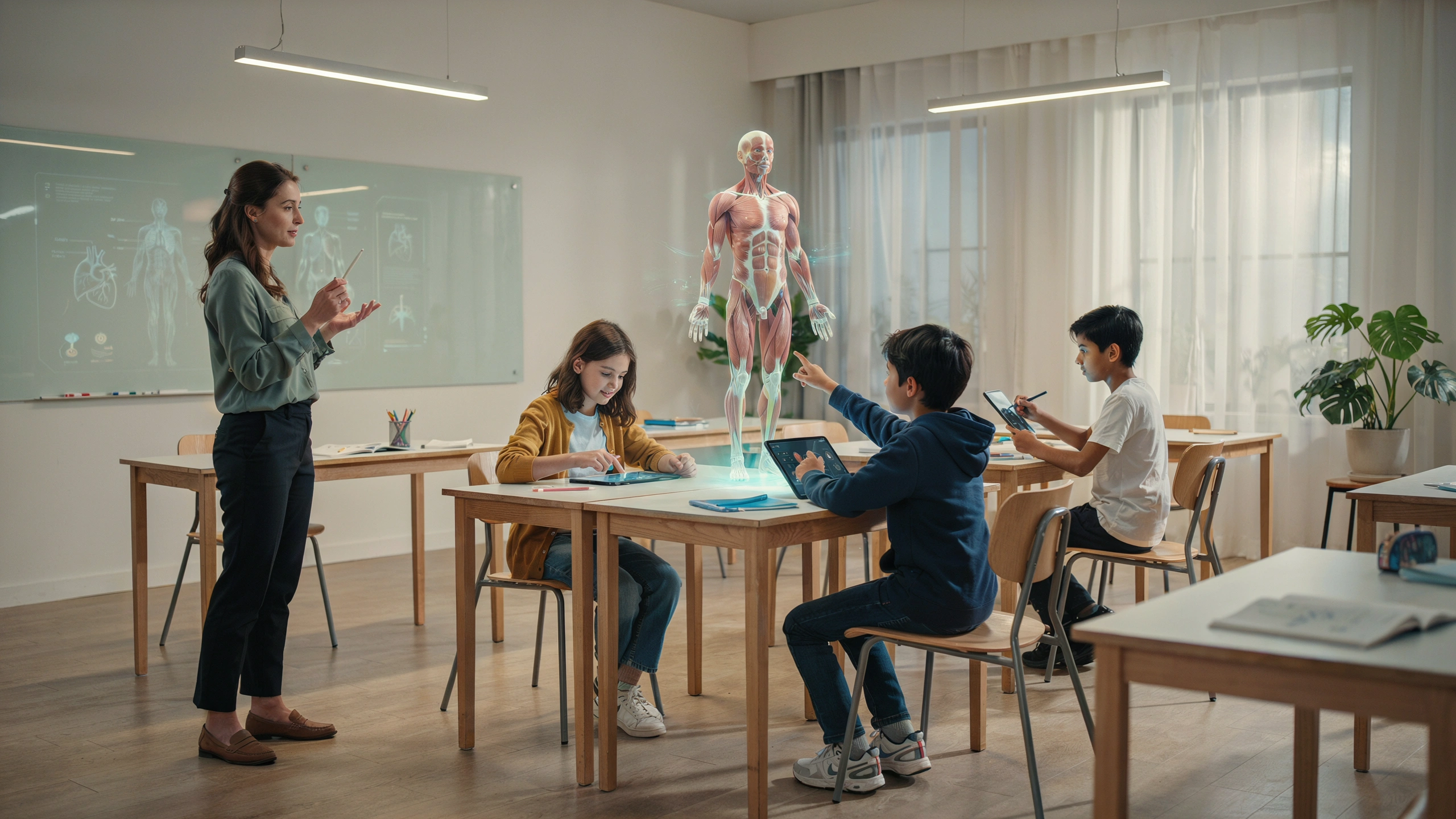
Education is constantly evolving as new technologies create exciting opportunities for teaching and learning. One of the most promising innovations is Augmented Reality (AR). Unlike traditional learning methods, Augmented Reality blends digital content with the real world, allowing students to interact with three-dimensional objects, animations, and information through smartphones, tablets, or AR glasses.
By making lessons more engaging and interactive, AR helps students better understand complex concepts, improve problem-solving skills, and stay motivated throughout the learning process. As schools continue to embrace digital transformation, Augmented Reality is becoming an increasingly valuable educational tool.
What Is Augmented Reality?
Augmented Reality is a technology that overlays digital information—such as images, videos, animations, or 3D models—onto the real-world environment.
Unlike Virtual Reality, which completely immerses users in a digital world, AR enhances the physical environment by adding interactive digital elements that users can view through mobile devices or specialized glasses.
For example, a biology student can point a tablet at a textbook illustration and instantly see a three-dimensional beating heart that can be rotated, enlarged, and explored from every angle.
This combination of physical and digital learning creates a richer educational experience.
How Augmented Reality Works in Education
Educational AR applications recognize images, objects, or surfaces and display digital content in response.
Students can:
- Scan textbook pages.
- Explore interactive 3D models.
- Watch scientific processes unfold.
- Complete AR learning activities.
- Participate in educational simulations.
- Receive instant explanations and visual demonstrations.
These experiences make abstract concepts easier to understand while increasing student participation.
Making Learning More Engaging
Student engagement is one of the greatest challenges in education.
Traditional lectures sometimes struggle to maintain students’ attention, especially when teaching complex or highly theoretical topics.
Augmented Reality transforms passive learning into active exploration. Instead of simply reading about a volcano, students can observe a realistic eruption on their classroom desk. Instead of studying the solar system through pictures, they can manipulate planets in three dimensions.
Interactive experiences naturally increase curiosity and encourage students to ask questions and investigate further.
Improving Understanding of Complex Concepts
Many academic subjects involve ideas that are difficult to visualize.
Augmented Reality allows students to examine detailed three-dimensional models of:
- Human organs
- Animal anatomy
- Chemical molecules
- Engineering structures
- Mathematical solids
- Historical artifacts
- Geographical landscapes
- Astronomical systems
Being able to rotate, zoom, and interact with these models significantly improves comprehension and long-term memory.
Enhancing Science Education
Science classrooms benefit greatly from AR technology.
Students can safely observe experiments that may be dangerous, expensive, or impossible to perform in a traditional classroom.
Examples include:
- Volcano eruptions
- DNA structures
- Cell division
- Chemical reactions
- Planetary motion
- Weather systems
- Ecosystem interactions
These visual experiences help students connect scientific theories with observable phenomena.
Supporting STEM Education
Augmented Reality has become an important resource for STEM education.
Engineering students can visualize mechanical designs before building them.
Mathematics students can manipulate geometric figures in three dimensions.
Technology and robotics learners can interact with virtual machines while understanding how different components function together.
These experiences strengthen analytical thinking and encourage innovation.
Language Learning Through Augmented Reality
AR also supports language education by making vocabulary learning more interactive.
Students can point their device at everyday objects and instantly see:
- Vocabulary words
- Pronunciation guides
- Example sentences
- Audio recordings
- Grammar explanations
This contextual learning approach improves vocabulary retention and language comprehension.
Interactive History and Geography Lessons
History becomes much more engaging when students can interact with historical artifacts or explore ancient civilizations in augmented reality.
Instead of viewing flat textbook images, learners can examine:
- Ancient monuments
- Historical buildings
- Archaeological discoveries
- Famous works of art
- Maps showing historical events
Geography lessons become equally immersive through interactive maps, landforms, climate models, and population data.
Encouraging Active Learning
Augmented Reality encourages students to become active participants rather than passive observers.
Instead of memorizing information, students investigate, manipulate objects, test ideas, and solve problems.
This active learning approach promotes:
- Critical thinking
- Creativity
- Collaboration
- Observation skills
- Scientific inquiry
- Independent learning
Students are more likely to retain information they actively discover themselves.
Supporting Different Learning Styles
Every student has unique learning preferences.
Augmented Reality supports multiple learning styles by combining:
- Visual learning through realistic graphics
- Auditory learning through narration and sound
- Kinesthetic learning through physical interaction
- Reading and writing through integrated text and explanations
This flexibility makes learning more accessible to diverse groups of students.
Increasing Student Motivation
Interactive technology naturally captures students’ interest.
Many AR learning applications include:
- Educational games
- Interactive quizzes
- Achievement badges
- Collaborative activities
- Digital rewards
These features encourage students to remain engaged and continue exploring educational content beyond classroom requirements.
Challenges of Using Augmented Reality
Although AR offers many educational benefits, schools should also consider several challenges.
Device Availability
Successful AR implementation often requires smartphones or tablets, which may not be available to every student.
Teacher Training
Teachers need guidance on selecting appropriate AR resources and integrating them into lesson plans effectively.
Technical Limitations
Older devices may struggle to run advanced AR applications, and reliable internet access is sometimes necessary.
Classroom Management
Interactive technology can become distracting if learning activities are not carefully planned and supervised.
Best Practices for Implementing AR
Schools can maximize the educational value of Augmented Reality by following several best practices:
- Align AR activities with curriculum goals.
- Introduce technology gradually.
- Combine AR with traditional teaching methods.
- Encourage collaboration during AR activities.
- Allow time for discussion and reflection.
- Choose age-appropriate educational applications.
- Evaluate learning outcomes regularly.
Thoughtful implementation ensures that technology enhances education rather than replacing effective teaching practices.
The Future of Augmented Reality in Education
As AR technology continues to improve, educational experiences will become even more immersive.
Future developments may include:
- AI-powered interactive tutors
- Smart AR glasses for classrooms
- Real-time language translation
- Personalized AR learning experiences
- Interactive laboratory simulations
- Collaborative global classrooms
- Career training using augmented environments
These innovations will continue to reshape how students learn and interact with educational content.
Conclusion
Augmented Reality is revolutionizing education by transforming ordinary lessons into immersive, interactive learning experiences. By combining digital content with the real world, AR helps students visualize complex concepts, engage more deeply with educational material, and develop critical thinking and problem-solving skills.
Although schools must address challenges such as device access, teacher training, and technical infrastructure, the benefits of AR are substantial. When integrated thoughtfully into classroom instruction, Augmented Reality creates meaningful learning experiences that inspire curiosity, improve understanding, and prepare students for a technology-driven future. As educational technology continues to evolve, AR is set to become an essential component of modern teaching and learning.