
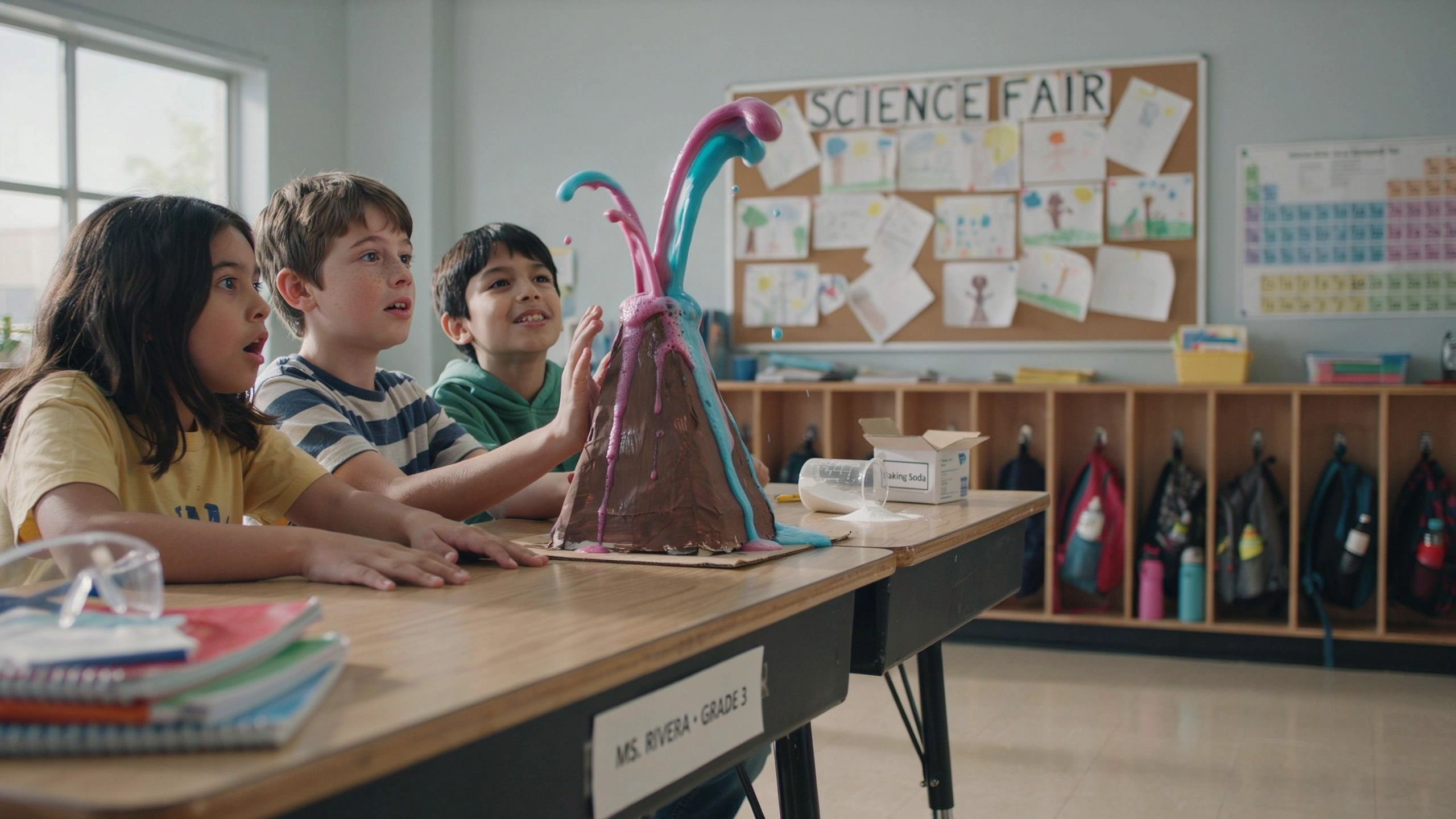
A homemade volcano is one of the most exciting science activities for children. With a few simple materials, kids can create a mini eruption while learning about chemical reactions, observation, and cause-and-effect relationships.
This classic science experiment combines creativity and discovery, making it a perfect STEM activity for classrooms, homeschooling, or family learning time.
Why Volcano Experiments Are Great for Kids
Volcano activities capture children’s attention because they create a visible reaction. Instead of only reading about science, children can watch a process happen in front of their eyes.
This experiment helps children:
- Understand basic chemistry concepts
- Develop observation skills
- Learn how reactions occur
- Practice making predictions
- Improve problem-solving abilities
- Encourage creativity through building and design
The excitement of an eruption makes science feel like an adventure.
Safety Tips Before Starting
Before beginning:
- Always supervise children during the experiment.
- Perform the activity on a tray or outdoors.
- Avoid contact with eyes.
- Use safe household materials only.
- Clean the area after the experiment.
This activity is safe when completed with proper supervision.
Understanding the Science Behind a Volcano
Before creating the volcano, explain the basic science.
A real volcano releases hot materials from deep inside Earth. While a homemade volcano does not produce real lava, it demonstrates a similar idea of gas and liquid being pushed out.
The reaction happens because:
- Baking soda is a base.
- Vinegar is an acid.
- When they combine, they create carbon dioxide gas.
- The gas creates bubbles that push liquid upward, producing an eruption effect.
This simple reaction introduces children to chemistry in an easy-to-understand way.
Activity: Build Your Own Volcano
Materials
For the volcano structure:
- Small plastic bottle
- Cardboard or a tray
- Paper or modeling clay
- Tape
- Paint (optional)
For the eruption:
- 2–3 tablespoons of baking soda
- Half a cup of vinegar
- Dish soap (optional)
- Food coloring (optional)
Step 1: Create the Volcano Shape
- Place the bottle in the center of a tray.
- Build a mountain shape around the bottle using paper, clay, or cardboard.
- Leave the bottle opening uncovered.
- Decorate your volcano with colors, rocks, or trees.
Encourage children to be creative and design their own volcano environment.
Step 2: Prepare the Eruption Mixture
- Add baking soda into the bottle.
- Add a few drops of food coloring.
- Add a small amount of dish soap for extra foam.
- Pour vinegar into the bottle.
- Watch the eruption begin.
Children can observe how quickly the reaction starts and how much foam is produced.
Science Investigation Questions
Encourage children to think like scientists:
- What do you think will happen before adding vinegar?
- Why does the mixture create bubbles?
- What changes when we add more baking soda?
- What happens if we use less vinegar?
- How can we make the eruption bigger or smaller?
These questions help children practice prediction and experimentation.
Experiment Variations
Variation 1: Change the Amount of Ingredients
Test different amounts of baking soda and vinegar.
Children can compare:
- Small reaction
- Medium reaction
- Large reaction
They can record which combination creates the biggest eruption.
Variation 2: Create Different Volcano Shapes
Build volcanoes using:
- Clay
- Sand
- Cardboard
- Recycled materials
Discuss how the shape affects the appearance of the eruption.
Variation 3: Add a Lava Color Experiment
Try different food coloring combinations:
- Red and yellow for lava
- Orange for a glowing effect
- Multiple colors for creative eruptions
This combines science with artistic creativity.
Extend Learning About Real Volcanoes
After the experiment, introduce children to real volcano science.
Discuss:
- How volcanoes form
- Why eruptions happen
- Different types of volcanoes
- Famous volcanoes around the world
- How scientists study volcanoes
Children can create drawings, models, or presentations about volcanoes.
Create a Volcano Science Journal
Encourage children to record:
- Their volcano design
- Materials used
- Predictions
- Observations
- Results
- Ideas for improvement
A science journal helps children understand that scientists document their experiments carefully.
Skills Children Develop
This activity supports the development of:
- Scientific thinking
- Observation skills
- Cause-and-effect understanding
- Creativity
- Fine motor skills
- Communication abilities
- Problem-solving
- Experimental thinking
It also encourages children to ask questions and search for explanations.
Fun Volcano Challenge
Turn the activity into a STEM challenge:
Challenge: Build the most creative volcano using recycled materials.
Children can:
- Design their volcano
- Choose materials
- Test their eruption
- Improve their design
- Explain their scientific ideas
This transforms a simple experiment into an engineering experience.
Final Thoughts
Building a homemade volcano with baking soda and vinegar is a simple activity that creates a powerful learning experience. Children discover chemistry, practice scientific thinking, and enjoy the excitement of creating something themselves.
The goal is not just the eruption—it is the curiosity, questions, and discoveries that happen along the way. With a few household materials, children can explore the wonders of science and develop skills that will support lifelong learning.