
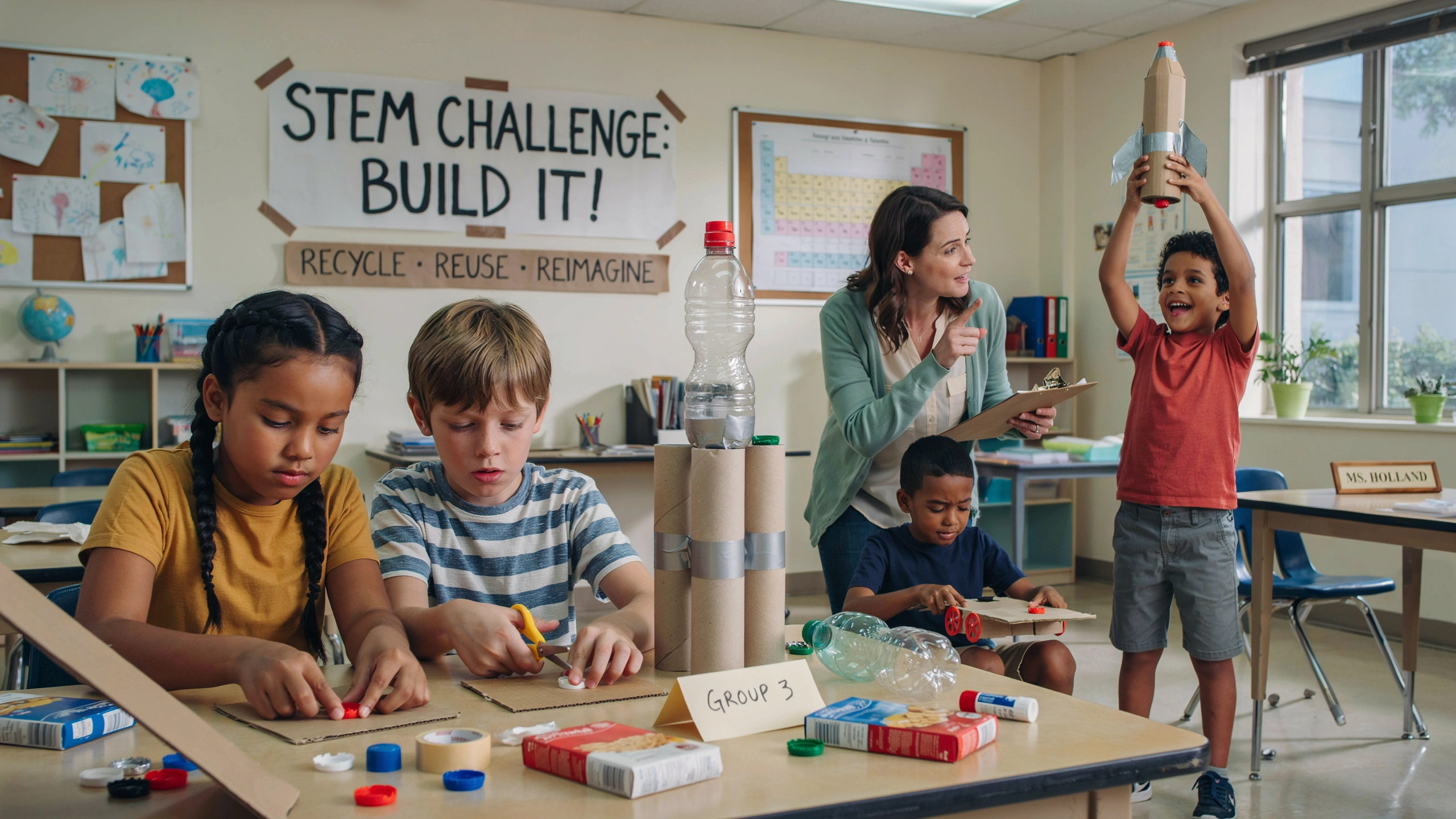
STEM activities are a wonderful way to help children develop creativity, problem-solving skills, and scientific thinking. The best part is that STEM projects do not require expensive equipment. Everyday recycled materials such as cardboard boxes, paper rolls, plastic bottles, and bottle caps can become exciting tools for engineering and discovery.
By transforming household items into creative projects, children learn that science and innovation can be found everywhere around them.
Why Recycled STEM Activities Are Valuable for Kids
Using recycled materials for STEM challenges combines science, technology, engineering, and mathematics in a fun and practical way.
These activities help children:
- Develop creative thinking
- Practice problem-solving
- Learn basic engineering concepts
- Improve planning skills
- Understand the value of recycling
- Build confidence through experimentation
STEM challenges also encourage children to learn from mistakes and improve their designs.
Safety Tips Before Starting
Before beginning STEM projects:
- Choose clean and safe recycled materials.
- Supervise children when using scissors or tools.
- Avoid sharp edges from cans or broken objects.
- Use child-friendly materials.
- Encourage children to organize their workspace.
A safe workspace allows children to focus on creativity and discovery.
Challenge 1: Build a Paper Tower
Materials
- Old newspapers or magazines
- Tape
- Scissors
- Ruler
Instructions
- Give children a limited amount of paper and tape.
- Challenge them to build the tallest tower possible.
- Measure the final height.
- Test whether the tower can stand on its own.
Science Behind It
Children explore balance, structure, and stability. Engineers use similar principles when designing tall buildings.
Challenge 2: Create a Cardboard Bridge
Materials
- Cardboard pieces
- Paper cups
- Tape
- Small toy cars or blocks
Instructions
- Build two supports using cups.
- Place cardboard across the supports.
- Test how much weight the bridge can hold.
- Modify the design to make it stronger.
Science Behind It
The shape and structure of a bridge affect its strength. Engineers use different designs to support heavy loads.
Challenge 3: Make a Plastic Bottle Rocket
Materials
- Empty plastic bottle
- Paper
- Tape
- Cardboard
- String
Instructions
- Decorate the bottle as a rocket.
- Add paper fins and a cone-shaped top.
- Create a launch area.
- Test how design changes affect movement.
Science Behind It
Children explore concepts like shape, air resistance, and motion.
Challenge 4: Build a Marble Maze
Materials
- Cardboard box lid
- Straws
- Paper strips
- Tape
- Marble
Instructions
- Create walls using straws or paper strips.
- Design a maze path.
- Place the marble inside.
- Guide it from start to finish.
Science Behind It
Children learn about gravity, movement, and problem-solving while designing pathways.
Challenge 5: Create a Recycled Robot
Materials
- Cardboard boxes
- Bottle caps
- Paper rolls
- Glue
- Markers
Instructions
- Design a robot using recycled items.
- Decide what functions the robot might have.
- Add creative features.
- Present the invention.
Science Behind It
This activity encourages imagination, design thinking, and understanding how objects can be combined to create new solutions.
Challenge 6: Build a Wind-Powered Car
Materials
- Cardboard
- Bottle caps
- Straws
- Wooden sticks
- Paper sail
Instructions
- Create a simple car frame.
- Attach wheels using bottle caps.
- Add a paper sail.
- Use a fan or wind outdoors to test movement.
Science Behind It
Children explore forces, energy, and how wind can create motion.
Challenge 7: Design a Recycling Sorting Game
Materials
- Empty containers
- Pictures of recyclable items
- Labels
Instructions
- Create different recycling categories.
- Mix pictures or objects together.
- Ask children to sort them correctly.
Science Behind It
Children learn about materials, classification, and environmental responsibility.
Encourage Engineering Thinking
During STEM challenges, ask children:
- What is your goal?
- What materials will you use?
- Why did your design work or fail?
- How can you improve it?
- What would happen if you changed one part?
These questions encourage children to think like engineers.
Skills Children Develop
Recycled STEM activities strengthen:
- Creativity
- Logical reasoning
- Planning skills
- Engineering thinking
- Collaboration
- Communication
- Persistence
- Mathematical skills
These abilities are important for future learning and real-world problem-solving.
Extend the Learning
Children can expand these activities by:
- Creating design sketches before building.
- Working in teams.
- Testing multiple versions of the same project.
- Recording results in a STEM journal.
- Researching famous inventions.
- Creating a classroom invention exhibition.
These extensions turn simple crafts into meaningful learning experiences.
Final Thoughts
STEM challenges using recycled materials prove that learning does not require expensive tools. With imagination and a few everyday objects, children can become designers, builders, and problem-solvers.
Every cardboard box, bottle, and piece of paper can become an opportunity for discovery. By encouraging children to create, test, and improve their ideas, parents and educators help develop the curiosity and innovation skills needed for the future.