
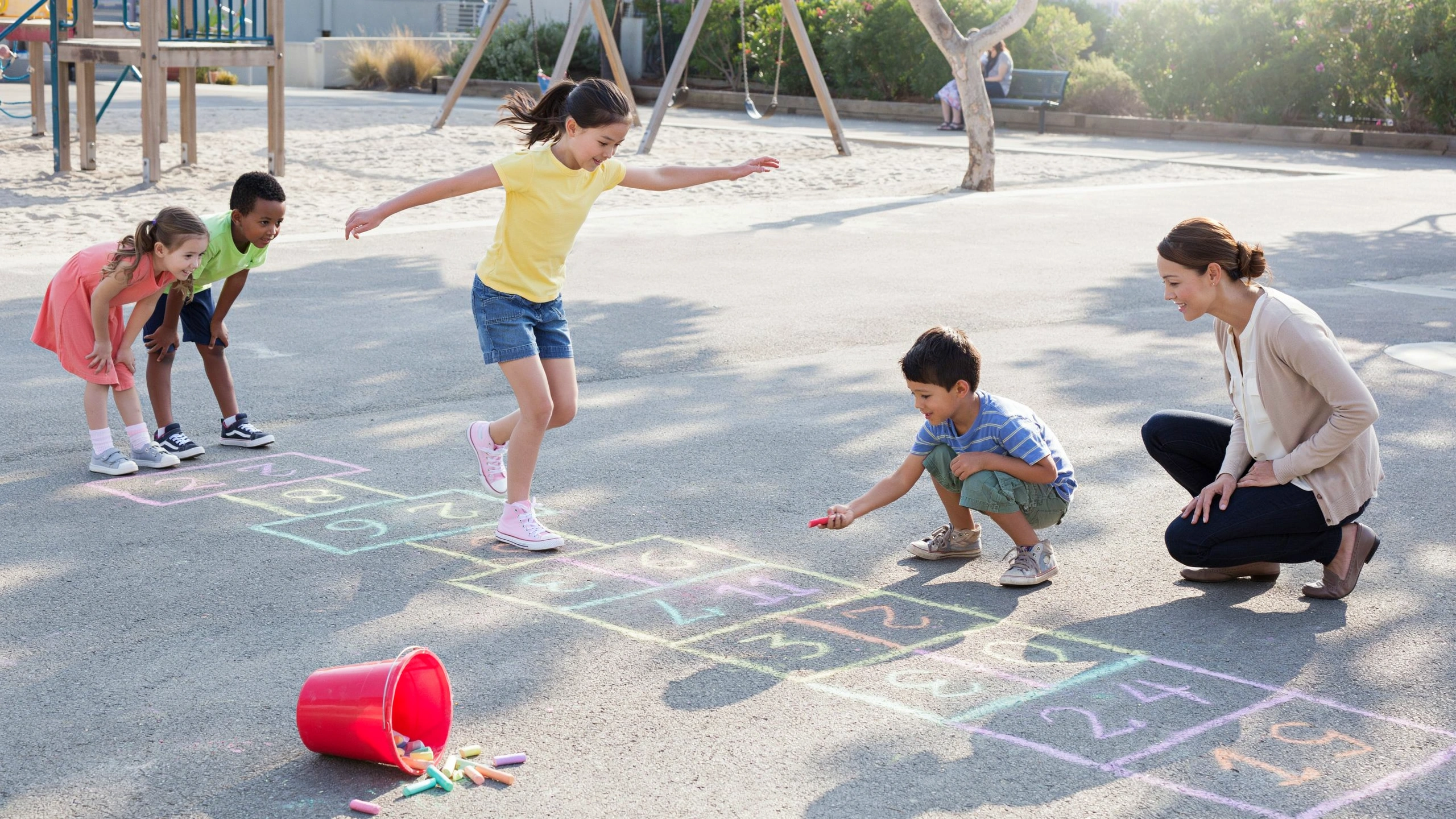
Hopscotch is one of the oldest and most beloved playground games, but it is also an excellent educational activity. With just a piece of chalk and a small open space, children can practice counting, recognize numbers, and understand number order while staying active. By combining movement with learning, hopscotch transforms early math lessons into exciting outdoor adventures.
Whether you’re a parent, teacher, or homeschool educator, hopscotch is an inexpensive and effective way to help young learners develop strong number skills through play.
Why Hopscotch Supports Early Math Skills
Physical movement helps children remember information more effectively. As they jump from one number to the next, they connect each numeral with its position in the counting sequence.
Hopscotch activities help children:
- Recognize numbers from 1 to 20 and beyond.
- Learn number order.
- Improve counting accuracy.
- Develop balance and coordination.
- Strengthen gross motor skills.
- Build concentration and memory.
- Increase confidence in early mathematics.
Most importantly, children enjoy learning because they see it as a game rather than a lesson.
1. Classic Counting Hopscotch
Draw a traditional hopscotch grid with numbers from 1 to 10.
Children toss a marker onto a square and hop through the course while saying each number aloud.
This activity reinforces:
- Number recognition.
- Counting in order.
- Balance and coordination.
It is perfect for beginners learning the counting sequence.
2. Backward Hopscotch
Once children are comfortable counting forward, challenge them to hop backward through the grid while counting in reverse.
For example:
10, 9, 8, 7, 6…
Backward counting strengthens memory and prepares children for subtraction concepts.
3. Skip Counting Hopscotch
Instead of using consecutive numbers, label the squares with skip-counting patterns such as:
- 2, 4, 6, 8, 10
- 5, 10, 15, 20
- 10, 20, 30, 40
Children hop while saying each number aloud, helping them recognize numerical patterns.
4. Missing Number Hopscotch
Leave one or more numbers blank.
Example:
1, 2, __, 4, 5
Before hopping, children identify the missing number and write it in the empty space.
This activity strengthens sequencing and problem-solving skills.
5. Even and Odd Hopscotch
Draw two hopscotch paths:
- One for even numbers.
- One for odd numbers.
Call out a number and ask children to jump onto the correct path.
This introduces the concepts of even and odd numbers in a fun, active way.
6. Addition Hopscotch
Write simple math problems beside each square.
For example:
- 2 + 1
- 4 + 3
- 5 + 2
Children solve the problem before hopping onto the square with the correct answer.
This game combines physical activity with basic addition practice.
7. Number Word Hopscotch
Instead of numerals, write number words such as:
- One
- Two
- Three
- Four
Children read each word before hopping.
This activity helps connect written words with numerical symbols.
8. Shape and Number Hopscotch
Draw different shapes inside each square.
For example:
- Circle
- Square
- Triangle
- Star
Children identify both the number and the shape before jumping.
This combines math with early geometry skills.
9. Color Hopscotch Challenge
Use different colored chalk for each number.
Ask children to follow instructions such as:
- Hop to the blue number 6.
- Jump to the yellow number 3.
- Find the green number 9.
Combining colors and numbers improves observation and listening skills.
10. Create Your Own Hopscotch Course
Invite children to design their own hopscotch board.
They can:
- Choose the numbers.
- Add colorful drawings.
- Include simple math questions.
- Create special jumping rules.
Designing the game encourages creativity while reinforcing number knowledge.
Tips for Successful Hopscotch Learning
Choose a flat, safe surface for jumping.
Use large, easy-to-read numbers.
Adapt the difficulty to match the child’s age and ability.
Encourage children to count aloud with every jump.
Mix different hopscotch variations to keep activities fresh and exciting.
Remember to celebrate participation, effort, and improvement.
Common Mistakes to Avoid
Avoid making the course too difficult for beginners.
Start with numbers 1 through 10 before expanding to larger numbers.
Do not rush children while they jump.
Allow time to think about each number before moving forward.
Avoid focusing only on speed.
Accurate counting and confidence are more important than finishing first.
Always ensure the play area is safe and free from obstacles.
Conclusion
Hopscotch is much more than a playground game—it is a powerful learning tool that helps children develop counting skills, understand number order, and build mathematical confidence through movement. Whether children are counting forward, hopping backward, solving simple addition problems, or identifying even and odd numbers, every jump reinforces important early math concepts.
By combining physical activity with playful learning, parents and educators create memorable experiences that inspire children to enjoy mathematics. With a little chalk and imagination, hopscotch becomes an exciting classroom without walls, where every hop brings young learners one step closer to mastering numbers.