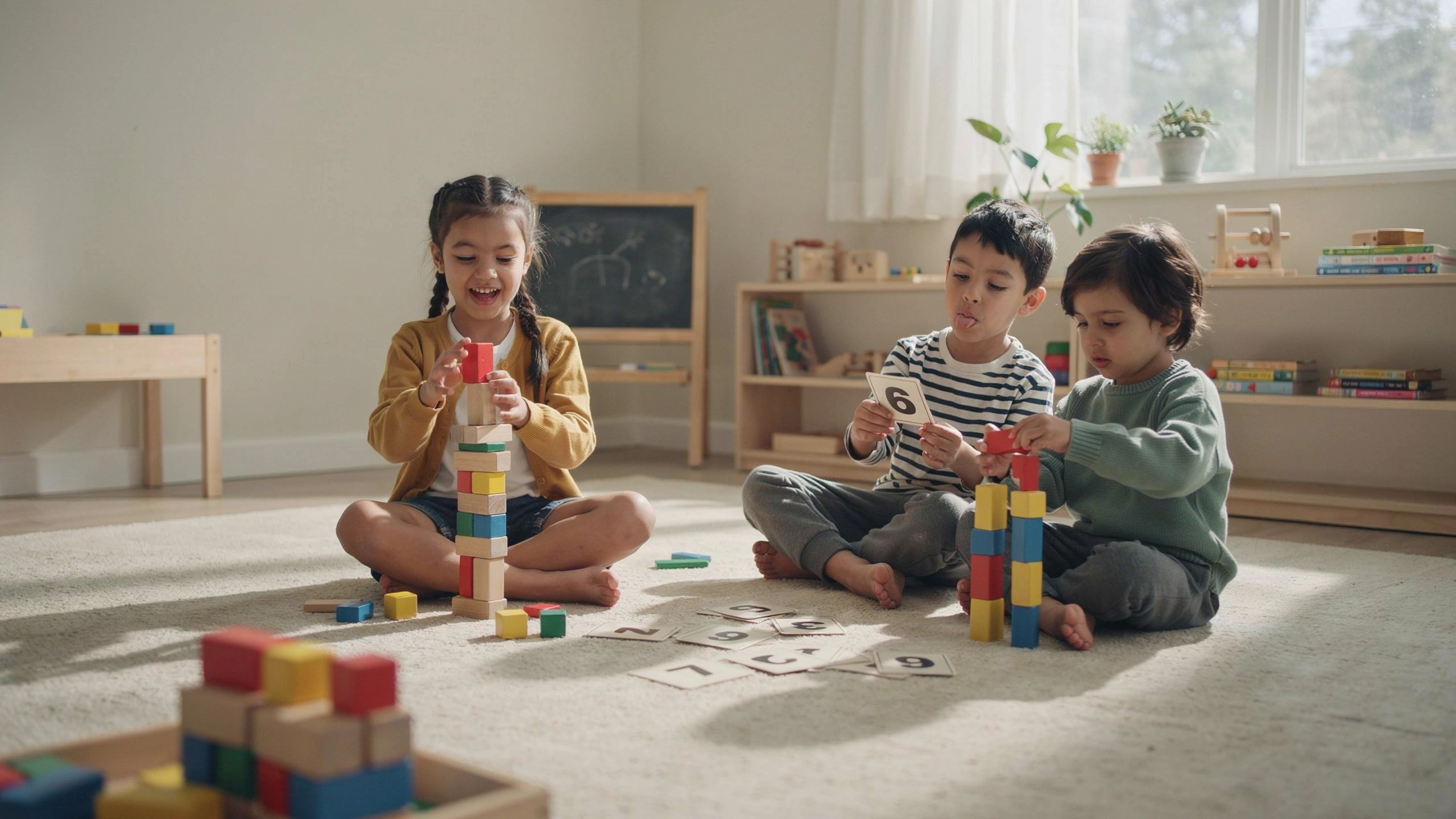
Building blocks are among the most versatile educational tools for young children. While they are often associated with creativity and construction, they are also excellent for teaching early math concepts. By stacking, sorting, counting, and comparing blocks, children naturally develop number recognition, counting skills, spatial awareness, and problem-solving abilities.
Whether you’re a parent, preschool teacher, or homeschool educator, building block activities can transform number learning into an exciting hands-on experience that children will love.
Why Building Blocks Support Early Math Learning
Blocks encourage children to learn by doing. As they build towers, count pieces, and compare heights, they begin to understand mathematical concepts through real-life experiences.
Building block activities help children:
- Recognize numbers from 1 to 20 and beyond.
- Practice one-to-one correspondence.
- Develop counting accuracy.
- Improve fine motor skills.
- Strengthen hand-eye coordination.
- Explore patterns and sequencing.
- Build confidence in problem-solving.
These activities also encourage creativity, teamwork, and independent thinking.
1. Number Tower Challenge
Write numbers on small cards and place them face down.
Children pick one card and build a tower using the exact number of blocks shown.
For example:
- Number 3 = Three blocks
- Number 7 = Seven blocks
- Number 10 = Ten blocks
After each tower is built, compare their heights and discuss which tower is taller or shorter.
2. Color and Count
Assign a different value to each block color or simply ask children to count blocks by color.
For example:
- Build a tower with 5 blue blocks.
- Add 3 yellow blocks.
- How many blocks are there altogether?
This activity combines counting with color recognition and simple addition.
3. Build the Missing Number
Arrange several towers in numerical order, leaving one number missing.
Example:
1, 2, 3, __, 5, 6
Children identify the missing number and build the correct tower.
This strengthens sequencing and logical thinking.
4. Roll and Stack Game
Use a die to determine how many blocks children can add to their towers.
Players take turns rolling the die and stacking the corresponding number of blocks.
The first player to reach a target height—such as 20 blocks—wins.
This game reinforces counting while introducing simple number comparisons.
5. Pattern Block Towers
Challenge children to create repeating patterns using different colored blocks.
Examples include:
- Red, Blue, Red, Blue
- Yellow, Green, Green, Yellow, Green, Green
- Red, Blue, Yellow, Red, Blue, Yellow
Once the pattern is complete, count how many blocks were used and identify the repeating sequence.
6. Number Card Matching
Place number cards on the table.
Children build block towers that match each number.
For additional practice, ask them to:
- Compare two towers.
- Find the tallest tower.
- Find the shortest tower.
- Arrange the towers from smallest to largest.
This activity reinforces both counting and comparison.
7. Build Your Age
Ask children to build a tower representing their age.
For example:
- A four-year-old builds a tower with four blocks.
- A six-year-old builds a tower with six blocks.
Extend the activity by comparing everyone’s towers and discussing who has more or fewer blocks.
8. Measure with Blocks
Choose classroom or household objects such as:
- A book
- A toy car
- A pencil case
- A water bottle
Children use blocks as non-standard measuring units.
For example:
- “The book is six blocks long.”
- “The toy car is four blocks long.”
This introduces the concept of measurement in a simple and engaging way.
9. Team Building Challenge
Divide children into small groups.
Give each team a number card and enough blocks to build the matching tower.
Once all towers are complete, arrange them in order from the smallest to the largest.
This activity encourages teamwork, communication, and mathematical reasoning.
10. Build, Count, and Record
After building each tower, children record their results by:
- Writing the number.
- Drawing the tower.
- Coloring the matching number of blocks.
Keeping a simple record reinforces number recognition and early writing skills.
Tips for Successful Building Block Activities
Use large, child-safe blocks for younger learners.
Start with small numbers before introducing larger quantities.
Encourage children to count each block aloud as they build.
Ask open-ended questions such as:
- Which tower is the tallest?
- How many more blocks do you need?
- Can you build a tower that is shorter?
- What happens if we add two more blocks?
These conversations deepen mathematical understanding.
Common Mistakes to Avoid
Avoid focusing only on building the tallest tower.
Encourage careful counting and thoughtful problem-solving instead.
Do not rush children through activities.
Give them time to experiment, rebuild, and explore different ideas.
Avoid correcting every mistake immediately.
Allow children to notice and fix their own counting errors whenever possible.
Most importantly, remember that learning through play is often the most effective approach.
Conclusion
Building blocks provide endless opportunities for children to explore numbers through hands-on learning. Whether they are constructing number towers, measuring objects, creating colorful patterns, or comparing heights, every activity strengthens counting, number recognition, and logical thinking.
By incorporating building block games into everyday learning, parents and educators create exciting experiences that make mathematics meaningful and enjoyable. Through creativity, exploration, and play, children develop the confidence and foundational skills they need for future success in math.