
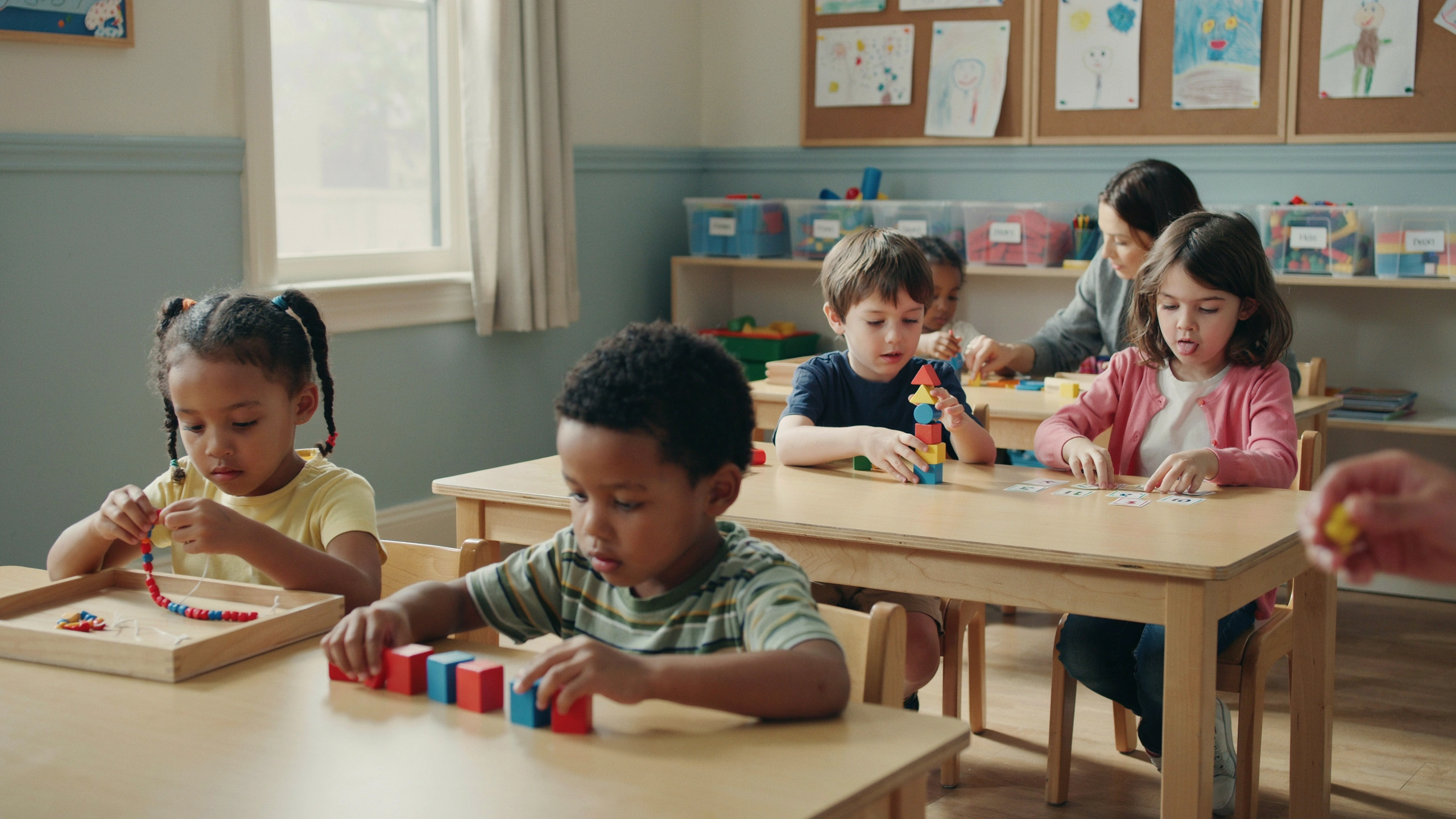
Recognizing patterns and understanding sequences are essential early math skills that help children make sense of the world around them. Before learning multiplication, division, or algebra, young learners benefit from identifying repeating patterns, arranging numbers in order, and predicting what comes next. Colorful number games make these concepts fun, engaging, and easy to understand.
Whether you’re teaching in a preschool classroom, homeschooling, or supporting learning at home, these hands-on activities encourage children to think logically while enjoying playful exploration.
Why Patterns and Sequencing Matter
Patterns and sequencing help children develop critical thinking and mathematical reasoning. They also improve memory, observation, and problem-solving skills that support future success in mathematics and science.
Pattern and sequencing activities help children:
- Recognize number order.
- Identify repeating patterns.
- Develop logical thinking.
- Improve concentration and memory.
- Strengthen problem-solving skills.
- Build early prediction abilities.
- Prepare for more advanced math concepts.
Learning through colorful games keeps children motivated and eager to explore.
1. Color Pattern Cards
Create cards using colorful circles, squares, or blocks arranged in simple patterns.
Examples include:
- Red, Blue, Red, Blue
- Yellow, Green, Yellow, Green
- Red, Yellow, Blue, Red, Yellow, Blue
Ask children to continue each pattern using matching colored objects.
This activity strengthens observation and prediction skills.
2. Number Sequence Puzzle
Write numbers on puzzle pieces and mix them up.
Children place the pieces in the correct order.
Begin with:
- 1–5
- 1–10
As confidence grows, increase the range to 20 or higher.
This reinforces counting and numerical sequencing.
3. Build Number Towers
Give children number cards and colorful building blocks.
They build towers with the correct number of blocks and arrange them from shortest to tallest.
Discuss how each tower grows by one block.
Children begin to recognize increasing numerical patterns.
4. Bead Pattern Necklaces
Provide beads in different colors.
Invite children to create repeating patterns such as:
- Blue, Green, Blue, Green
- Red, Yellow, Yellow, Red, Yellow, Yellow
Once complete, count the beads in each pattern and identify the repeating section.
This activity combines creativity with early math skills.
5. Missing Number Game
Arrange number cards in sequence but remove one or more numbers.
For example:
- 1, 2, __, 4, 5
- 6, 7, 8, __, 10
Children identify the missing numbers and place them correctly.
This game strengthens logical reasoning and number recognition.
6. Hop Along the Number Line
Draw a large number line on the floor or sidewalk.
Children hop from one number to the next while counting aloud.
Try different challenges such as:
- Counting backward.
- Skip counting by twos.
- Hop only on odd numbers.
- Hop only on even numbers.
Movement helps children remember number sequences more effectively.
7. Pattern Block Designs
Use colorful pattern blocks to build simple designs.
Challenge children to continue the design by following the established pattern.
Encourage them to explain why they chose each shape or color.
This promotes mathematical reasoning and communication.
8. Everyday Object Sequencing
Gather familiar household items such as:
- Spoons
- Cups
- Books
- Toy cars
- Building blocks
Ask children to arrange them by:
- Size
- Length
- Height
- Quantity
Discuss the order using words like:
- First
- Next
- Last
- Bigger
- Smaller
Sequencing everyday objects helps children understand ordering concepts.
9. Number Train Activity
Create paper train cars labeled with numbers.
Mix the cars together and invite children to rebuild the train in numerical order.
Older children can extend the train beyond 20 or create skip-counting trains.
This playful activity strengthens sequencing while encouraging teamwork.
10. Create Your Own Pattern Challenge
Invite children to invent their own colorful patterns using:
- Stickers
- Buttons
- Blocks
- Crayons
- Colored paper
After creating the pattern, ask a friend or family member to continue it.
Designing patterns encourages creativity while reinforcing mathematical thinking.
Tips for Teaching Patterns and Sequencing
Start with simple patterns before introducing more complex ones.
Use bright, colorful materials to capture children’s attention.
Encourage children to describe patterns aloud.
Ask open-ended questions such as:
- What comes next?
- Why did you choose that color?
- Can you make a different pattern?
- How is this sequence changing?
Repeat activities often to strengthen understanding.
Celebrate creative ideas as well as correct answers.
Common Mistakes to Avoid
Avoid introducing several pattern types at once.
Focus on one concept before moving to another.
Do not rush children through sequencing activities.
Allow time to observe, compare, and think independently.
Avoid correcting mistakes immediately.
Instead, encourage children to look carefully and identify the pattern themselves.
Remember that learning patterns is a gradual process that develops with practice.
Conclusion
Teaching patterns and sequencing through colorful number games helps children build a strong mathematical foundation while encouraging creativity and logical thinking. Whether they are building towers, creating bead necklaces, solving number puzzles, or designing their own patterns, every activity strengthens observation, prediction, and problem-solving skills.
By making patterns part of everyday play, parents and educators help children discover that mathematics is all around them. These enjoyable learning experiences prepare young learners for future success while fostering curiosity, confidence, and a lifelong love of learning.