
Introduction
Riddles have entertained children for generations, but they are much more than simple jokes or word games. Every riddle encourages children to think carefully, examine clues, and look beyond the most obvious answer. Instead of relying on memorization, children learn to analyze information, make logical connections, and use their imagination to solve problems.
Whether shared during family time, in the classroom, or on a long car ride, riddles are an enjoyable way to strengthen reasoning and creativity. Best of all, they require no special materials—just curiosity and a willingness to think.
What Makes Riddles So Valuable?
A good riddle challenges children to pause and think. It often has a surprising answer that requires looking at the question from a different perspective.
As children solve riddles, they learn to:
- Analyze clues carefully
- Think creatively
- Consider multiple possibilities
- Explain their reasoning
- Learn from mistakes
These habits support both academic learning and everyday problem-solving.
1. Riddles Develop Logical Reasoning
Most riddles cannot be solved by guessing alone. Children must examine every clue and eliminate answers that don’t fit.
For example:
Riddle: What has a face and two hands but no arms or legs?
Answer: A clock.
Solving riddles teaches children to connect facts logically before reaching a conclusion.
Skills Developed:
- Deductive reasoning
- Logical thinking
- Analysis
- Decision-making
2. They Encourage Creative Thinking
Many riddles have unexpected answers that require children to think “outside the box.”
Instead of looking for the obvious solution, they learn to consider new perspectives and imagine different possibilities.
Creative thinking helps children become more flexible when solving real-life problems.
3. Riddles Expand Vocabulary
Children often discover new words and expressions while solving riddles.
Adults can pause to explain unfamiliar vocabulary, making riddles an enjoyable language-learning activity.
Skills Developed:
- Vocabulary
- Reading comprehension
- Language development
- Communication
4. Riddles Improve Listening Skills
When riddles are read aloud, children must listen carefully to every word because each clue is important.
This strengthens:
- Active listening
- Concentration
- Memory
- Attention to detail
These skills are essential for success in school.
5. They Teach Patience and Persistence
Not every riddle is solved immediately.
Children learn that it’s okay to:
- Think for a while
- Try different ideas
- Make mistakes
- Keep searching for clues
This builds resilience and a positive attitude toward learning.
6. Riddles Strengthen Problem-Solving Skills
Every riddle presents a small challenge that requires children to:
- Gather information
- Analyze clues
- Eliminate impossible answers
- Reach a logical conclusion
These same problem-solving steps are useful in mathematics, science, and everyday life.
7. They Spark Interesting Conversations
Riddles naturally encourage discussion.
Parents and teachers can ask questions such as:
- Why did you choose that answer?
- Which clue helped you the most?
- Can you think of another possible answer?
These conversations strengthen reasoning and communication skills.
8. Children Learn to Think Independently
Instead of immediately asking for the answer, children begin trusting their own thinking.
As they solve more riddles, they become more confident in their ability to reason through unfamiliar challenges.
This independence encourages lifelong learning.
9. Creating Riddles Is Even More Challenging
Writing original riddles requires children to think carefully about objects, ideas, and language.
For example, a child might write:
“I have pages but I’m not a tree. I tell stories, but I don’t speak. What am I?”
Answer: A book.
Inventing riddles develops both creativity and logical thinking.
10. Riddles Make Learning Fun
Perhaps the greatest benefit of riddles is that children enjoy solving them.
Riddles can be used:
- During family meals
- In the classroom
- Before bedtime
- On road trips
- During morning meetings
- As quick brain breaks
Learning becomes exciting because every riddle feels like a mystery waiting to be solved.
Tips for Using Riddles with Children
To make riddle time enjoyable:
- Choose riddles appropriate for your child’s age.
- Give children enough time to think.
- Encourage them to explain their answers.
- Accept creative responses when they make sense.
- Mix easy and challenging riddles to maintain interest.
- Invite children to write their own riddles.
Remember, the goal is to develop thinking skills—not simply to find the correct answer.
Sample Riddles for Kids
Here are a few simple riddles to get started:
1. What gets wetter the more it dries?
Answer: A towel.
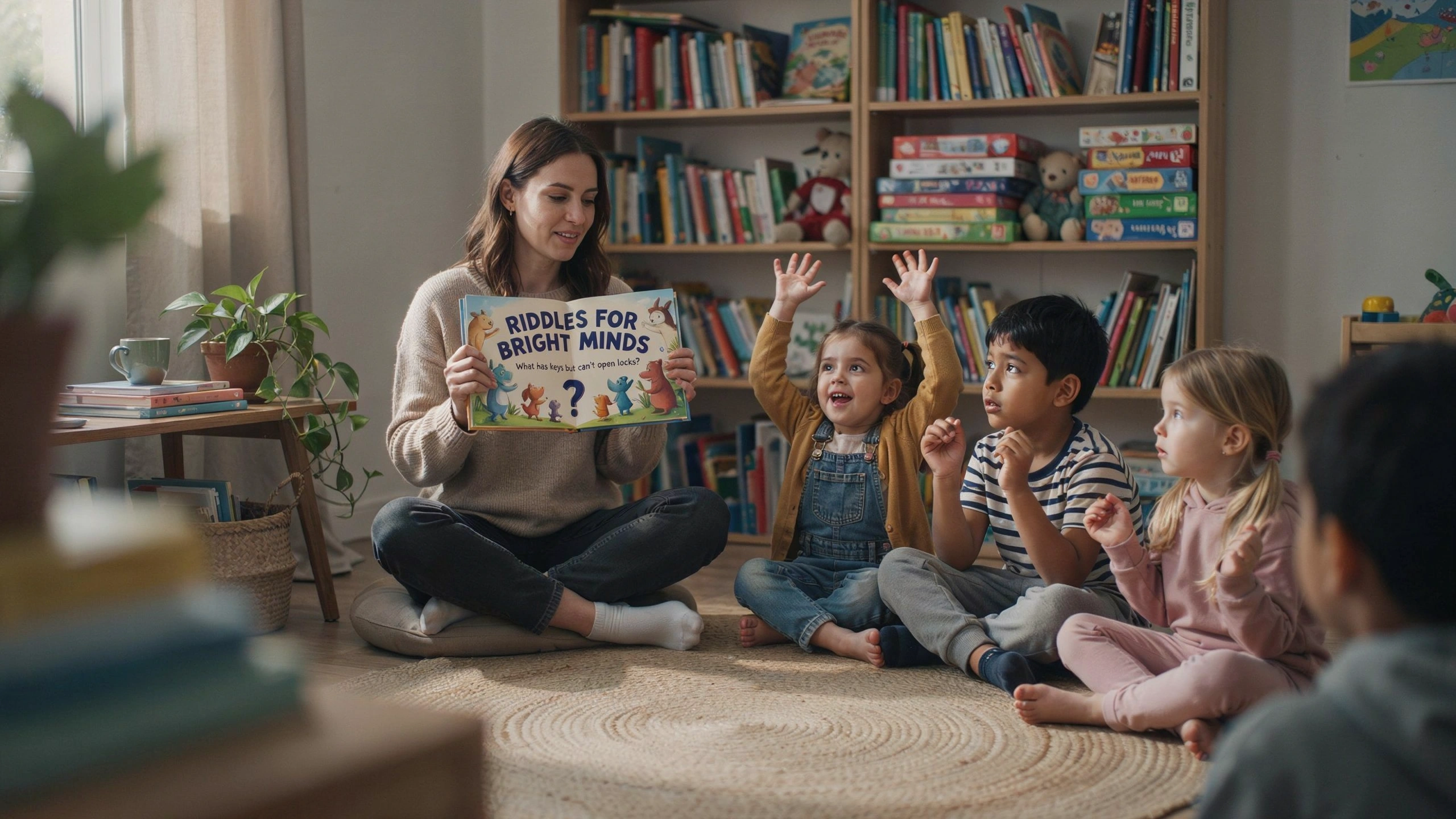
2. What has keys but can’t open locks?
Answer: A piano.
3. What has one eye but cannot see?
Answer: A needle.
4. What can travel around the world while staying in one place?
Answer: A stamp.
5. What comes once in a minute, twice in a moment, but never in a thousand years?
Answer: The letter M.
Conclusion
Riddles are one of the simplest yet most effective ways to develop children’s reasoning and creativity. Every puzzle encourages young learners to think carefully, analyze clues, communicate ideas, and explore new perspectives. Along the way, they build confidence, improve language skills, and discover that learning can be both challenging and enjoyable.
By making riddles a regular part of daily life, parents and teachers can nurture curious minds and help children become thoughtful, imaginative, and independent problem solvers.