
Introduction
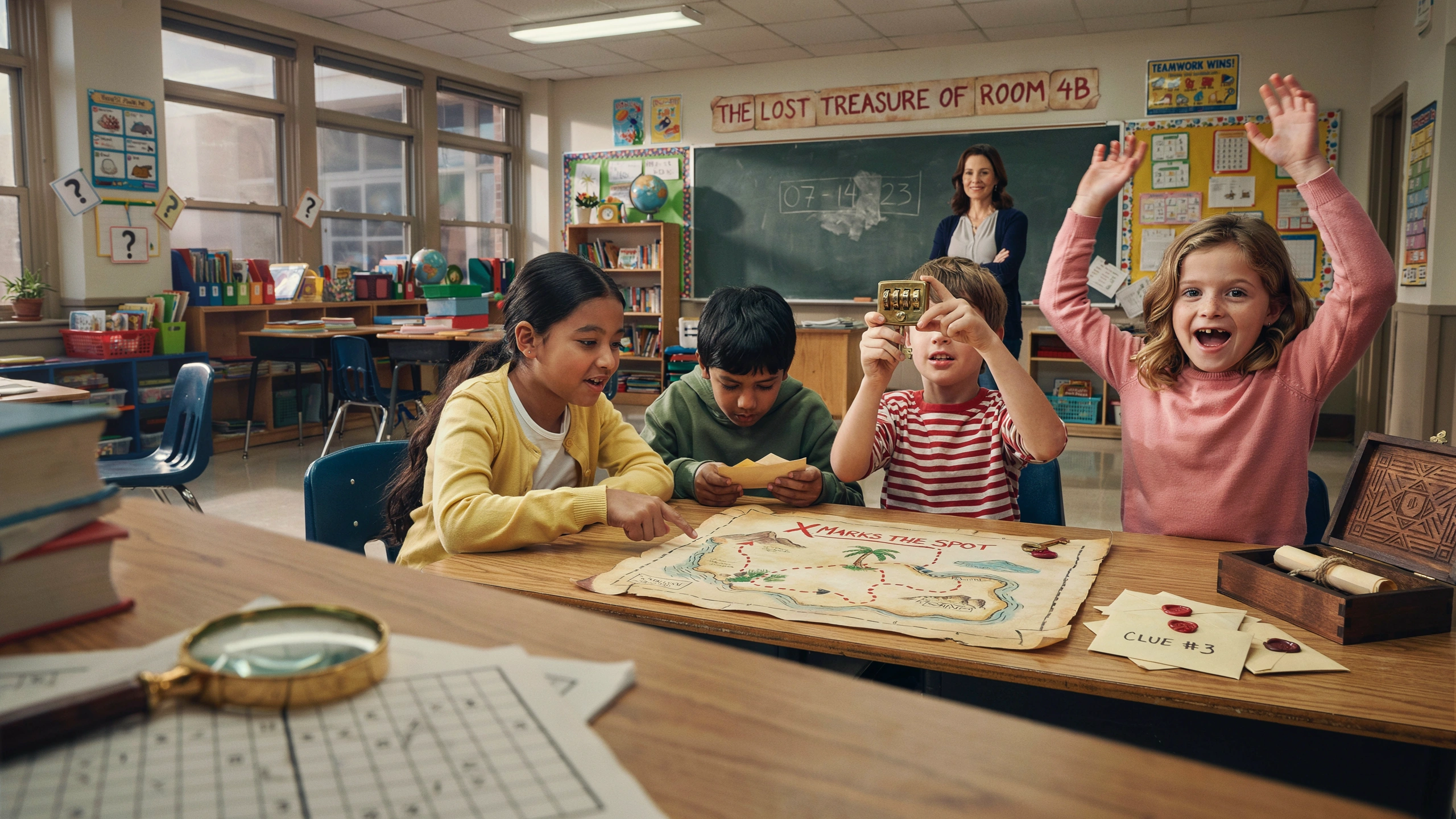
Escape rooms have become one of the most exciting educational activities for children. Instead of simply answering questions, kids work together to solve puzzles, uncover clues, and complete challenges before time runs out. Every task encourages them to think critically, communicate effectively, and use logic to progress through the game.
The best part is that you don’t need a professional escape room to enjoy these benefits. With a little creativity, parents and teachers can create fun escape room activities at home or in the classroom using everyday objects and simple puzzles.
What Is an Escape Room?
An escape room is a game in which players solve a series of puzzles and challenges to achieve a goal, such as opening a treasure box, finding a hidden object, or “escaping” from a fictional room.
Children must:
- Observe carefully
- Solve problems
- Work together
- Follow clues
- Think logically
- Stay organized
Each solved puzzle leads to the next challenge until the final mystery is completed.
Why Escape Rooms Are Great for Learning
Escape room activities combine multiple thinking skills in one exciting experience.
Children learn to:
- Analyze information
- Make logical connections
- Test different ideas
- Communicate clearly
- Manage time wisely
- Stay calm under pressure
Because every clue matters, children remain engaged from beginning to end.
1. Treasure Hunt Escape
Hide clues around the house or classroom. Each clue leads to the next until children discover the “treasure.”
Example Challenges:
- Solve a simple riddle.
- Complete a number sequence.
- Find an object that matches a description.
- Decode a short message.
Skills Developed:
- Deductive reasoning
- Observation
- Sequencing
- Problem-solving
2. Secret Code Challenge
Create simple coded messages using:
- Letter substitutions
- Number codes
- Picture symbols
- Color patterns
Children must decode each message before moving forward.
Skills Developed:
- Pattern recognition
- Logical reasoning
- Attention to detail
- Critical thinking
3. Puzzle Piece Mission
Divide a picture into puzzle pieces and hide them around the room.
Children solve clues to collect every piece before assembling the final image.
Skills Developed:
- Observation
- Collaboration
- Spatial reasoning
- Planning
4. Mystery Object Escape
Place several mystery objects in a box.
Give clues describing one object at a time.
Children identify the correct object before receiving the next clue.
Skills Developed:
- Deductive reasoning
- Vocabulary
- Observation
- Logical thinking
5. Pattern Lock Puzzle
Instead of using a real lock, children solve a repeating pattern to discover a secret number or word.
Example:
Red – Blue – Red – Blue – ?
Correct answers reveal the next challenge.
Skills Developed:
- Pattern recognition
- Sequencing
- Prediction
- Logical analysis
6. Math Mission
Include simple age-appropriate math puzzles such as:
- Number patterns
- Basic calculations
- Counting challenges
- Shape recognition
Each correct answer unlocks another clue.
Skills Developed:
- Mathematical reasoning
- Problem-solving
- Concentration
- Logical thinking
7. Reading Detective Escape
Provide short stories with hidden clues.
Children answer questions using information from the text before continuing.
Skills Developed:
- Reading comprehension
- Evidence-based reasoning
- Observation
- Critical thinking
8. Nature Explorer Escape
Hide clues outdoors in the garden or park.
Children solve challenges related to:
- Leaves
- Flowers
- Trees
- Insects
- Rocks
This combines science learning with adventure.
Skills Developed:
- Scientific observation
- Curiosity
- Teamwork
- Problem-solving
9. Teamwork Challenge
Design puzzles that require two or more children to cooperate.
Examples include:
- Sharing different clues
- Solving separate puzzles that connect together
- Completing tasks simultaneously
Children discover that teamwork often leads to faster solutions.
Skills Developed:
- Communication
- Collaboration
- Leadership
- Listening
10. Final Escape Puzzle
End the activity with one exciting challenge that combines clues from earlier puzzles.
For example:
- Arrange collected letters into a secret word.
- Put picture pieces together.
- Solve one final riddle.
- Enter a simple code to “unlock” the treasure.
This gives children a satisfying sense of achievement.
Tips for Creating a Successful Escape Room
Keep the experience enjoyable by following these suggestions:
- Choose puzzles appropriate for the children’s ages.
- Mix easy and challenging tasks.
- Offer hints if frustration begins to grow.
- Encourage teamwork instead of competition.
- Celebrate creative thinking and persistence.
- Focus on fun rather than speed.
Remember, the goal is learning through exploration—not creating impossible challenges.
Skills Children Develop
Escape room activities strengthen many important abilities, including:
- Critical thinking
- Logical reasoning
- Observation
- Communication
- Teamwork
- Creativity
- Decision-making
- Time management
- Persistence
These skills support success across school subjects and everyday situations.
Conclusion
Escape room activities transform learning into an exciting adventure where every clue leads to new discoveries. By solving puzzles, decoding messages, recognizing patterns, and working together, children strengthen critical thinking while building confidence and cooperation.
Whether you’re planning a classroom activity, a birthday party, or a family game night, escape rooms offer an engaging way to develop problem-solving skills through play. Every mystery solved helps children become more curious, independent, and creative thinkers.