
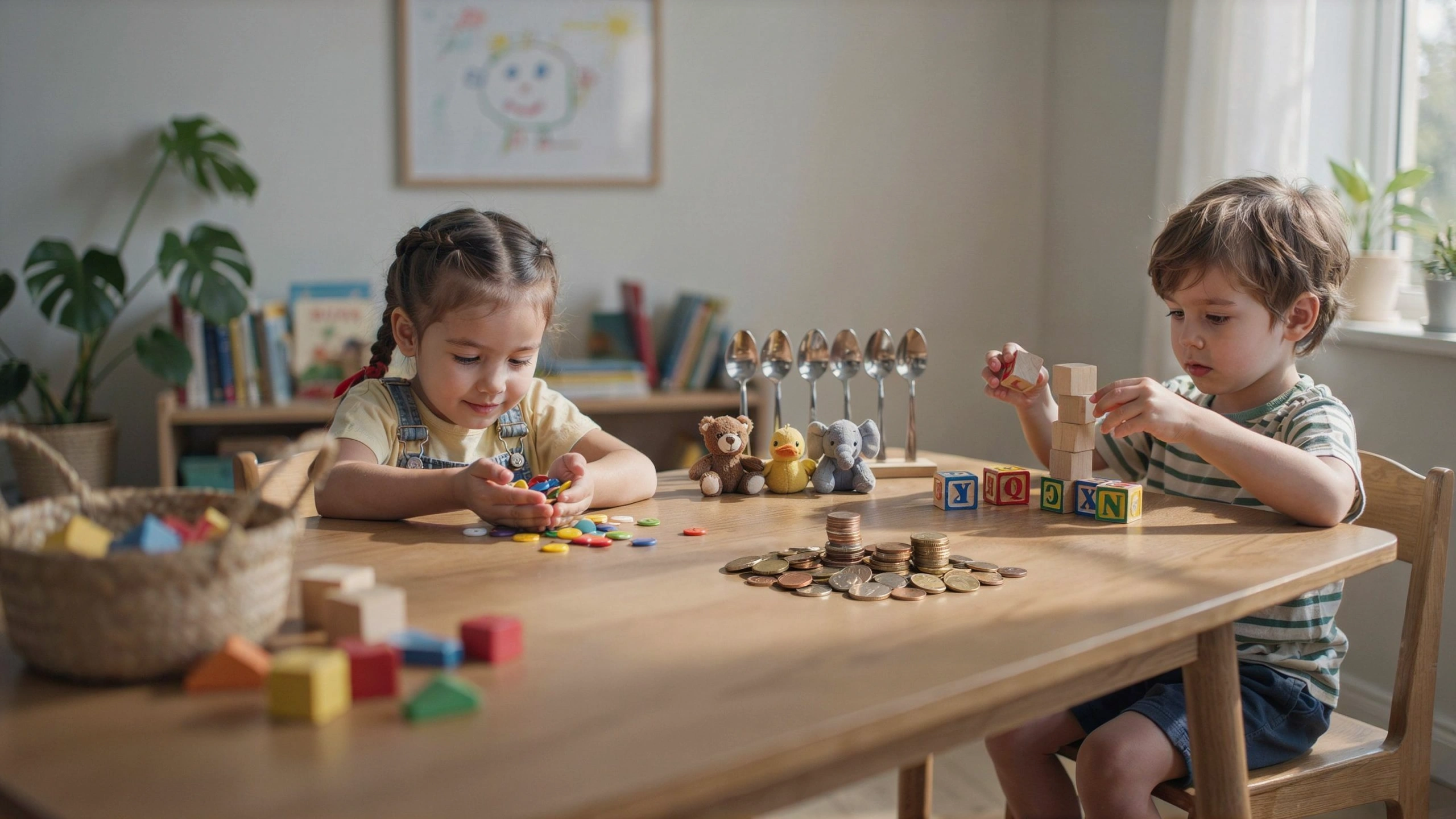
Teaching children how to count doesn’t require expensive educational toys or complicated lesson plans. In fact, some of the best math activities can be created using everyday household items that are already available at home. Simple counting games help children develop number recognition, one-to-one correspondence, problem-solving skills, and confidence in early math—all while having fun.
Whether you’re a parent, caregiver, homeschool educator, or preschool teacher, these easy counting games will turn ordinary objects into exciting learning tools.
Why Counting Games Are Important
Counting is one of the first math skills children learn. Through hands-on activities, children begin to understand that numbers represent quantities and that counting follows a predictable sequence.
Counting games help children:
- Recognize numbers from 1 to 20 and beyond.
- Develop one-to-one correspondence.
- Improve memory and concentration.
- Build fine motor skills.
- Strengthen logical thinking.
- Prepare for addition and subtraction.
- Increase confidence in early mathematics.
Learning through play encourages children to explore numbers naturally and at their own pace.
1. Spoon Counting Game
Gather several spoons from the kitchen and write numbers on small pieces of paper.
Ask children to place the correct number of small objects—such as beans, buttons, or pom-poms—into each spoon.
For example:
- Spoon 1 = 1 button
- Spoon 2 = 2 beans
- Spoon 5 = 5 pom-poms
This activity develops counting accuracy and hand-eye coordination.
2. Sock Pair Counting
After doing laundry, invite children to help match socks into pairs.
Once the pairs are made, ask questions like:
- How many pairs are there?
- How many socks altogether?
- Can you count backward?
This turns a daily chore into a fun math lesson.
3. Egg Carton Number Match
Label the compartments of an empty egg carton with numbers.
Children place the matching number of small objects into each section.
You can use:
- Coins
- Pebbles
- Beads
- Pasta
- Bottle caps
This game strengthens number recognition and one-to-one correspondence.
4. Toy Animal Counting
Gather toy animals, cars, or building blocks.
Roll a die and ask children to count out the matching number of toys.
For extra practice, ask:
- Which group has more?
- Which has fewer?
- How many are left?
Children begin comparing quantities while practicing counting.
5. Snack Counting Activity
Use healthy snacks such as:
- Grapes
- Crackers
- Cereal pieces
- Blueberries
- Pretzels
Give children a number card and ask them to count out the correct amount before eating the snack.
Learning becomes even more motivating when there’s a tasty reward at the end.
6. Coin Counting Challenge
Collect a variety of coins.
For younger children, simply count the coins.
Older children can:
- Sort by size.
- Compare quantities.
- Count total amounts.
- Practice simple money skills.
Always supervise young children when using small objects.
7. Building Block Towers
Write numbers on cards.
Children build towers using the exact number of blocks shown.
For example:
- Number 4 = Four blocks
- Number 8 = Eight blocks
After building, compare tower heights and discuss which is tallest or shortest.
8. Clothespin Number Match
Write numbers on index cards.
Children clip the matching number of clothespins onto each card.
This activity improves:
- Counting skills.
- Finger strength.
- Fine motor development.
- Number recognition.
It also prepares children for writing by strengthening hand muscles.
9. Button Sorting and Counting
Collect colorful buttons.
Ask children to sort them by:
- Color
- Size
- Shape
After sorting, count each group together.
This activity combines early math with observation and classification skills.
10. Staircase Counting Game
Turn every trip up the stairs into a counting adventure.
Children count each step as they climb.
To increase the challenge:
- Count backward.
- Skip count by twos.
- Count by fives or tens for older learners.
Everyday routines become valuable learning opportunities.
Tips for Successful Counting Activities
Keep learning playful rather than formal.
Use familiar household objects to make math feel relevant.
Encourage children to touch each object while counting to strengthen one-to-one correspondence.
Repeat favorite games regularly to reinforce number concepts.
Praise effort and persistence more than correct answers.
Short, enjoyable practice sessions are more effective than long lessons.
Common Mistakes to Avoid
Avoid introducing too many numbers at once.
Begin with small groups before moving to larger quantities.
Do not rush children while they count.
Allow time to point to each object carefully.
Avoid correcting every mistake immediately.
Instead, encourage children to count again and discover the correct answer independently.
Most importantly, make counting enjoyable rather than stressful.
Conclusion
Everyday household items offer endless opportunities to teach counting in fun and meaningful ways. From sorting buttons and building block towers to counting snacks and matching socks, simple activities help children develop essential early math skills while strengthening fine motor coordination, concentration, and confidence.
By incorporating counting games into everyday routines, parents and educators show children that math is everywhere. These playful experiences create a strong foundation for future learning and help children discover that numbers can be exciting, practical, and fun.