
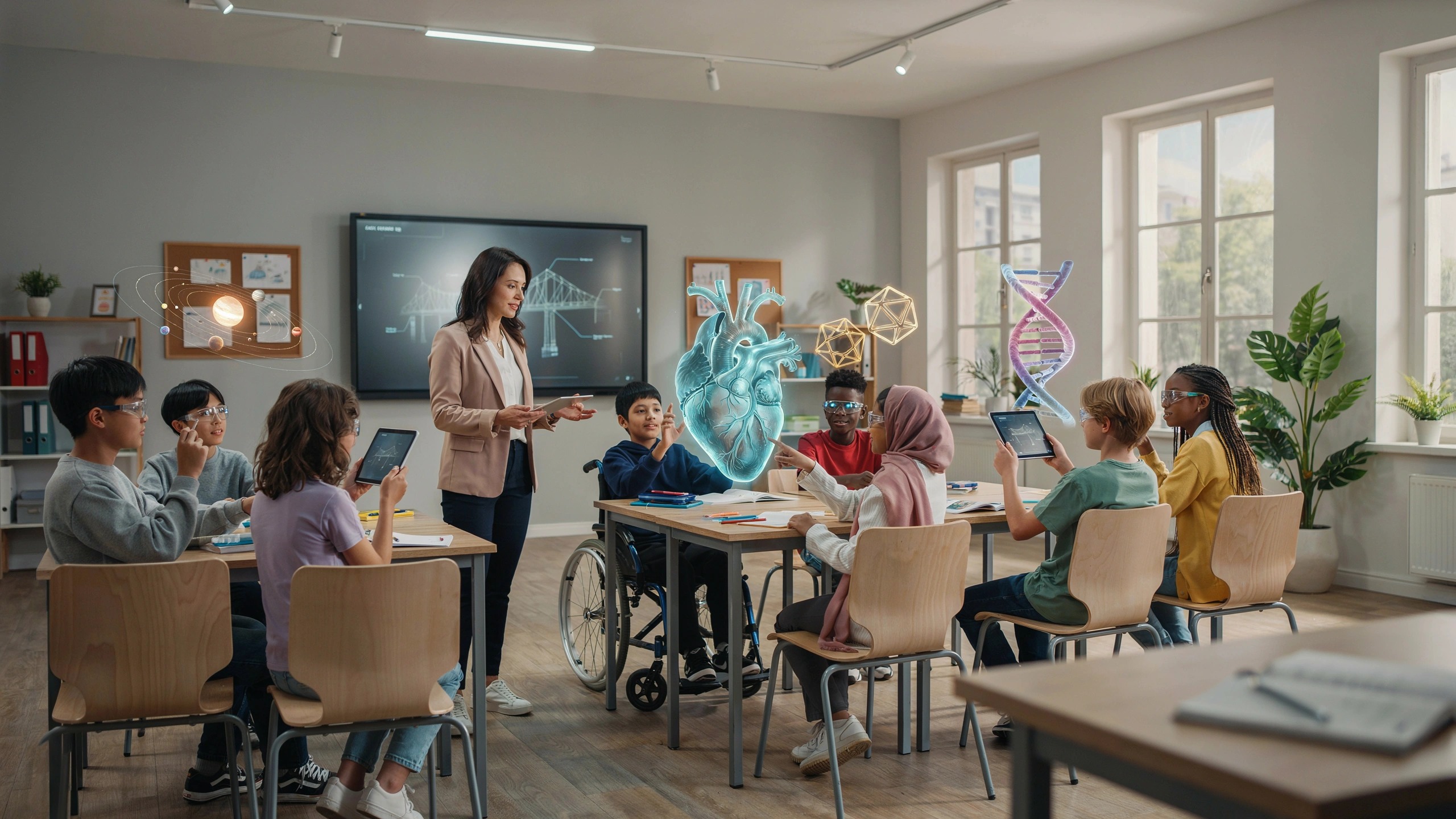
Education is becoming increasingly interactive as schools adopt new technologies that enhance the learning experience. Among the most exciting innovations is Augmented Reality (AR), a technology that overlays digital content—such as images, animations, 3D models, sounds, and videos—onto the real world through smartphones, tablets, smart glasses, or AR-enabled devices.
Unlike Virtual Reality (VR), which immerses users in a completely digital environment, Augmented Reality enhances the physical world by adding interactive digital elements to it. This unique capability allows students to explore complex concepts in engaging and memorable ways. From examining the human heart in three dimensions to exploring ancient civilizations or conducting virtual science experiments, AR is transforming classrooms into dynamic learning environments.
As educational technology continues to evolve, Augmented Reality is becoming an essential tool for improving engagement, understanding, collaboration, and creativity.
What Is Augmented Reality?
Augmented Reality is a technology that combines the real world with computer-generated digital content. Using a camera and specialized software, AR devices recognize physical objects or environments and display additional digital information on the screen.
Educational AR experiences may include:
- Interactive 3D models
- Animated diagrams
- Virtual laboratory experiments
- Historical reconstructions
- Geographic visualizations
- Language learning activities
- Engineering simulations
- Mathematical demonstrations
Students remain aware of their real surroundings while interacting with digital learning materials.
Why Augmented Reality Matters in Education
Traditional teaching methods sometimes make abstract concepts difficult to understand.
Reading about the solar system or viewing two-dimensional textbook images may not fully communicate complex ideas.
Augmented Reality allows students to:
- Visualize invisible processes.
- Manipulate three-dimensional objects.
- Observe detailed structures.
- Explore realistic simulations.
- Connect theory with practice.
Learning becomes more interactive and meaningful through direct exploration.
Increasing Student Engagement
One of the greatest strengths of AR is its ability to capture students’ attention.
Interactive experiences encourage learners to actively participate rather than passively observe.
Students can:
- Rotate 3D objects.
- Explore virtual environments.
- Complete interactive challenges.
- Conduct digital investigations.
- Participate in collaborative activities.
Active engagement improves motivation while making lessons more enjoyable.
Improving Knowledge Retention
Research suggests that students remember information more effectively when they actively interact with learning materials.
AR strengthens memory by combining:
- Visual learning
- Hands-on exploration
- Real-world context
- Interactive experiences
Instead of memorizing isolated facts, students build meaningful understanding through direct experience.
This deeper engagement often leads to improved long-term knowledge retention.
Making Complex Concepts Easier to Understand
Many academic subjects involve ideas that are difficult to observe directly.
Augmented Reality simplifies topics such as:
- Human anatomy
- Molecular structures
- Chemical reactions
- Planetary motion
- Engineering systems
- Architecture
- Geometry
Students can examine objects from multiple angles, zoom into details, and observe processes that would otherwise remain invisible.
Supporting STEM Education
AR has become particularly valuable in Science, Technology, Engineering, and Mathematics (STEM) education.
Students can:
- Conduct virtual science experiments.
- Assemble engineering models.
- Explore robotics concepts.
- Visualize mathematical shapes.
- Investigate biological structures.
These interactive experiences promote inquiry-based learning while reducing the cost of physical laboratory equipment.
Encouraging Collaboration
Augmented Reality supports collaborative learning by allowing students to work together on shared digital experiences.
Groups may:
- Solve scientific challenges.
- Build virtual models.
- Analyze historical artifacts.
- Complete engineering projects.
- Explore interactive learning scenarios.
Collaboration strengthens communication, teamwork, and problem-solving skills.
Supporting Inclusive Education
AR technologies can improve accessibility for learners with diverse educational needs.
Features may include:
- Audio explanations
- Visual enhancements
- Language translation
- Adjustable content sizes
- Interactive guidance
- Personalized learning pathways
These adaptations help create inclusive classrooms where every student can participate actively.
Enhancing Field Trips
Not every school has the opportunity to organize visits to museums, laboratories, or historical sites.
AR makes virtual field experiences possible.
Students can:
- Explore ancient civilizations.
- Visit famous landmarks.
- Examine museum collections.
- Observe wildlife habitats.
- Tour space stations.
- Investigate archaeological discoveries.
These immersive experiences expand learning opportunities regardless of location.
Encouraging Creativity
Students are not limited to consuming AR content—they can also create it.
AR creation projects encourage learners to:
- Design interactive presentations.
- Build digital exhibitions.
- Develop educational storytelling.
- Produce science demonstrations.
- Create virtual museum displays.
These activities strengthen creativity, communication, and digital literacy.
Challenges of Augmented Reality
Despite its educational benefits, AR also presents several challenges.
Equipment Costs
AR devices and software require financial investment.
Although smartphones and tablets reduce costs, advanced AR systems may still be expensive for some schools.
Teacher Training
Educators need professional development to integrate AR effectively into classroom instruction.
Technology alone does not guarantee improved learning outcomes.
Technical Limitations
Successful AR experiences require:
- Compatible devices
- Reliable internet access
- Updated software
- Technical support
Schools must ensure appropriate infrastructure before implementation.
Screen Time
As with other educational technologies, AR should be balanced with traditional classroom activities to avoid excessive screen exposure.
Best Practices for Implementing AR
Successful Augmented Reality programs include:
- Aligning AR activities with learning objectives.
- Using AR to enhance—not replace—quality teaching.
- Encouraging collaboration.
- Providing teacher training.
- Ensuring accessibility.
- Evaluating educational effectiveness.
- Combining digital experiences with hands-on learning.
Thoughtful implementation maximizes educational value.
The Future of Augmented Reality in Education
AR technology continues to advance rapidly.
Future innovations may include:
- AI-powered AR learning assistants.
- Smart AR glasses for classrooms.
- Real-time multilingual translation.
- Interactive holographic lessons.
- Personalized AR learning pathways.
- Advanced collaborative learning spaces.
- Fully immersive mixed reality classrooms.
These developments will create even richer educational experiences that connect the physical and digital worlds.
Conclusion
Augmented Reality is transforming education by bringing lessons to life through interactive digital experiences that enhance the real world. By making complex concepts easier to understand, increasing student engagement, supporting collaboration, and improving knowledge retention, AR creates meaningful learning opportunities across all educational levels.
Although challenges such as equipment costs, teacher training, technical infrastructure, and screen time must be addressed, the educational potential of Augmented Reality is enormous. As schools continue to adopt innovative technologies, AR will play an increasingly important role in building engaging, inclusive, and future-ready learning environments that inspire curiosity, creativity, and lifelong learning.