
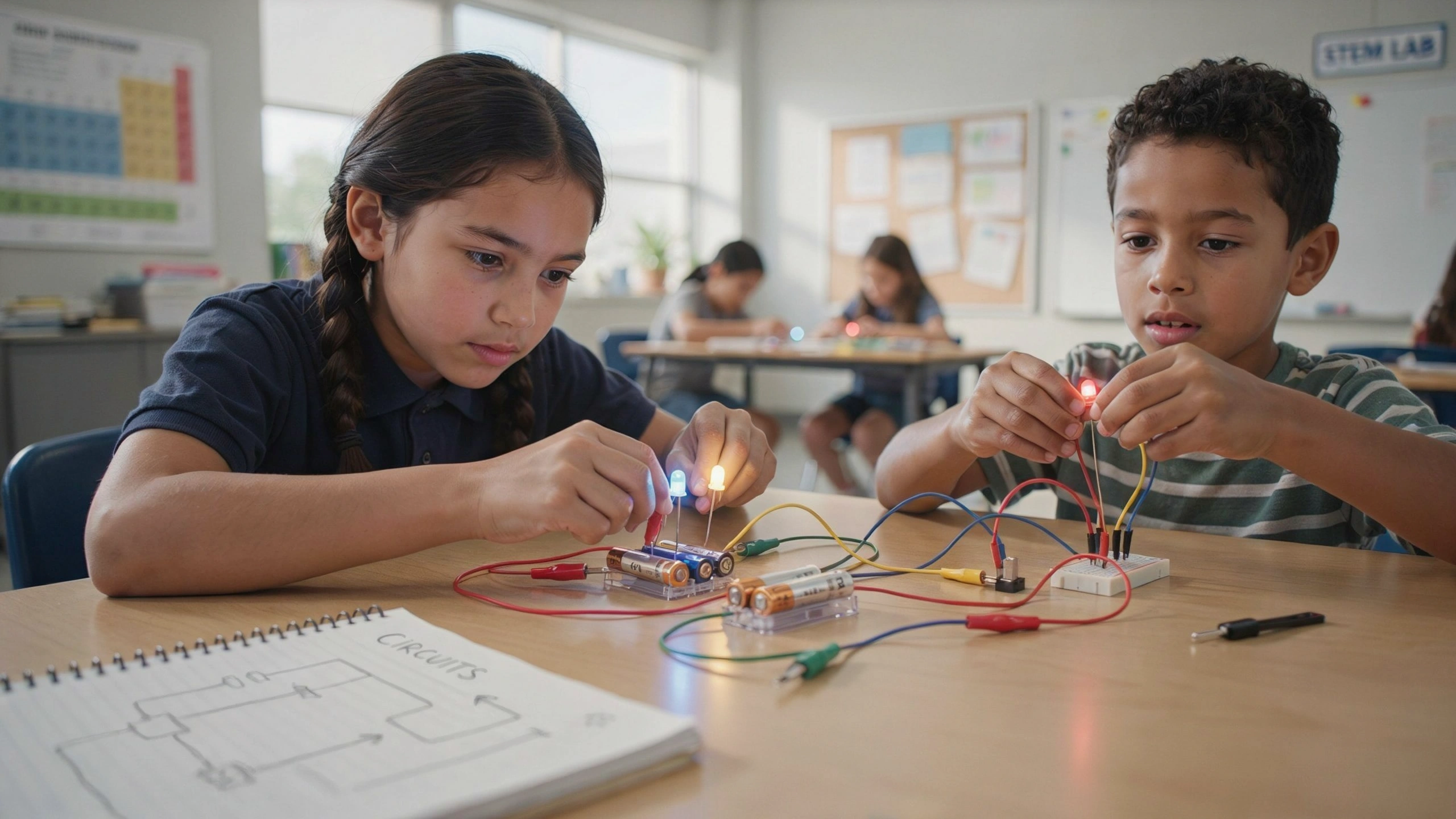
Electricity powers our homes, schools, computers, and countless everyday devices. While it may seem complicated, children can begin learning the basics of electricity through safe, hands-on experiments using low-voltage batteries and LED lights. These simple activities introduce important STEM concepts such as circuits, conductors, insulators, and energy transfer.
With proper supervision and a few inexpensive materials, young learners can become junior engineers while discovering how electricity works.
Why Teach Children About Electricity?
Electricity experiments help children understand how energy moves and powers everyday objects. They also encourage curiosity and problem-solving through hands-on investigation.
Benefits include:
- Introducing basic physics concepts
- Developing logical thinking
- Encouraging engineering skills
- Improving observation and problem-solving
- Building confidence through experimentation
- Inspiring interest in STEM careers
Children quickly discover that electricity follows specific paths and rules.
Safety First
Electricity should always be explored safely.
Before beginning:
- Use only low-voltage batteries (AA, AAA, or coin-cell batteries recommended for educational kits).
- Never use household wall outlets for experiments.
- Do not connect batteries directly to each other.
- Keep batteries away from very young children.
- Adult supervision is required during every activity.
- Disconnect circuits when experiments are finished.
Following these rules ensures a safe and enjoyable learning experience.
What Is Electricity?
Electricity is the movement of tiny particles called electrons through a material.
For electricity to flow, it needs:
- A power source (battery)
- Conductive wires
- An electrical device (such as an LED)
- A complete circuit
If the circuit is broken, electricity cannot flow.
Activity 1: Light an LED
Materials
- AA battery
- Battery holder
- LED light
- Two wires with alligator clips
Instructions
- Connect the battery holder to the battery.
- Attach one wire to the positive terminal.
- Connect the other wire to the negative terminal.
- Attach the LED correctly.
- Observe what happens.
Science Behind It
Electricity flows through the closed circuit and powers the LED, converting electrical energy into light.
Activity 2: Build a Simple Circuit
Materials
- Battery
- Battery holder
- LED
- Wires
- Small switch (optional)
Instructions
- Connect the battery, wires, and LED.
- Test the circuit.
- Add a switch to turn the light on and off.
Science Behind It
A complete circuit allows electrons to flow continuously from one battery terminal to the other.
Activity 3: Conductors and Insulators
Materials
- Battery
- LED
- Wires
- Metal spoon
- Plastic spoon
- Wooden stick
- Coin
- Aluminum foil
Instructions
- Complete the circuit using different materials.
- Observe which materials allow the LED to light.
Science Behind It
Conductors allow electricity to pass through easily, while insulators block the flow of electricity.
Activity 4: Make a Paper Circuit
Materials
- Copper tape
- Coin-cell battery
- LED
- Cardstock
Instructions
- Create a simple circuit path with copper tape.
- Attach the battery.
- Connect the LED.
- Fold the paper to complete the circuit.
Science Behind It
Paper circuits demonstrate that electricity can travel through conductive materials arranged in a complete path.
Activity 5: Create an Electric Quiz Board
Materials
- Cardboard
- Brass fasteners
- Wires
- Battery
- LED
Instructions
- Create matching questions and answers.
- Connect the correct pairs behind the board.
- Test each answer.
- The LED lights only when the correct answer completes the circuit.
Science Behind It
The circuit only closes when the correct electrical path is completed.
Activity 6: Build a Simple Flashlight
Materials
- Cardboard tube
- LED
- Battery
- Copper tape
- Tape
Instructions
- Assemble the battery and LED inside the tube.
- Add copper tape to complete the circuit.
- Turn the flashlight on and off by connecting the circuit.
Science Behind It
Portable devices use simple electrical circuits to provide light whenever the circuit is closed.
Activity 7: Engineering Challenge
Challenge
Design your own electrical invention.
Ideas include:
- Greeting card with lights
- Mini reading lamp
- Light-up house model
- Decorative star
- Traffic light model
Draw the design before building it.
Science Behind It
Engineers combine scientific knowledge with creativity to solve real-world problems.
Encourage Scientific Thinking
Ask children:
- Why didn’t the LED light at first?
- What happens if the circuit is broken?
- Which materials conducted electricity?
- Why are batteries important?
- How can we improve our design?
These questions help children think like scientists and engineers.
Skills Children Develop
Electricity activities strengthen:
- Scientific reasoning
- Engineering design
- Observation skills
- Logical thinking
- Problem-solving
- Fine motor coordination
- Creativity
- Persistence
These skills are essential for future STEM learning.
Extend the Learning
Children can continue exploring electricity by:
- Building series and parallel circuits.
- Learning how household appliances work.
- Investigating renewable energy sources.
- Exploring solar-powered devices.
- Visiting a science museum.
- Researching famous inventors such as Thomas Edison and Nikola Tesla.
These activities help connect simple experiments to modern technology.
Real-World Applications
Electricity powers nearly every aspect of modern life. Children can identify examples such as:
- Lights
- Computers
- Refrigerators
- Electric vehicles
- Traffic signals
- Medical equipment
Understanding electricity helps children appreciate the science and engineering behind everyday technology.
Final Thoughts
Electricity experiments using batteries and LED lights provide an exciting introduction to physics and engineering. By building simple circuits, testing conductive materials, and solving practical challenges, children gain valuable STEM skills while having fun.
Every successful circuit teaches an important lesson: science is about exploring, experimenting, and discovering how the world works. With safe materials and curious minds, young learners can begin their journey into the fascinating world of electricity.