
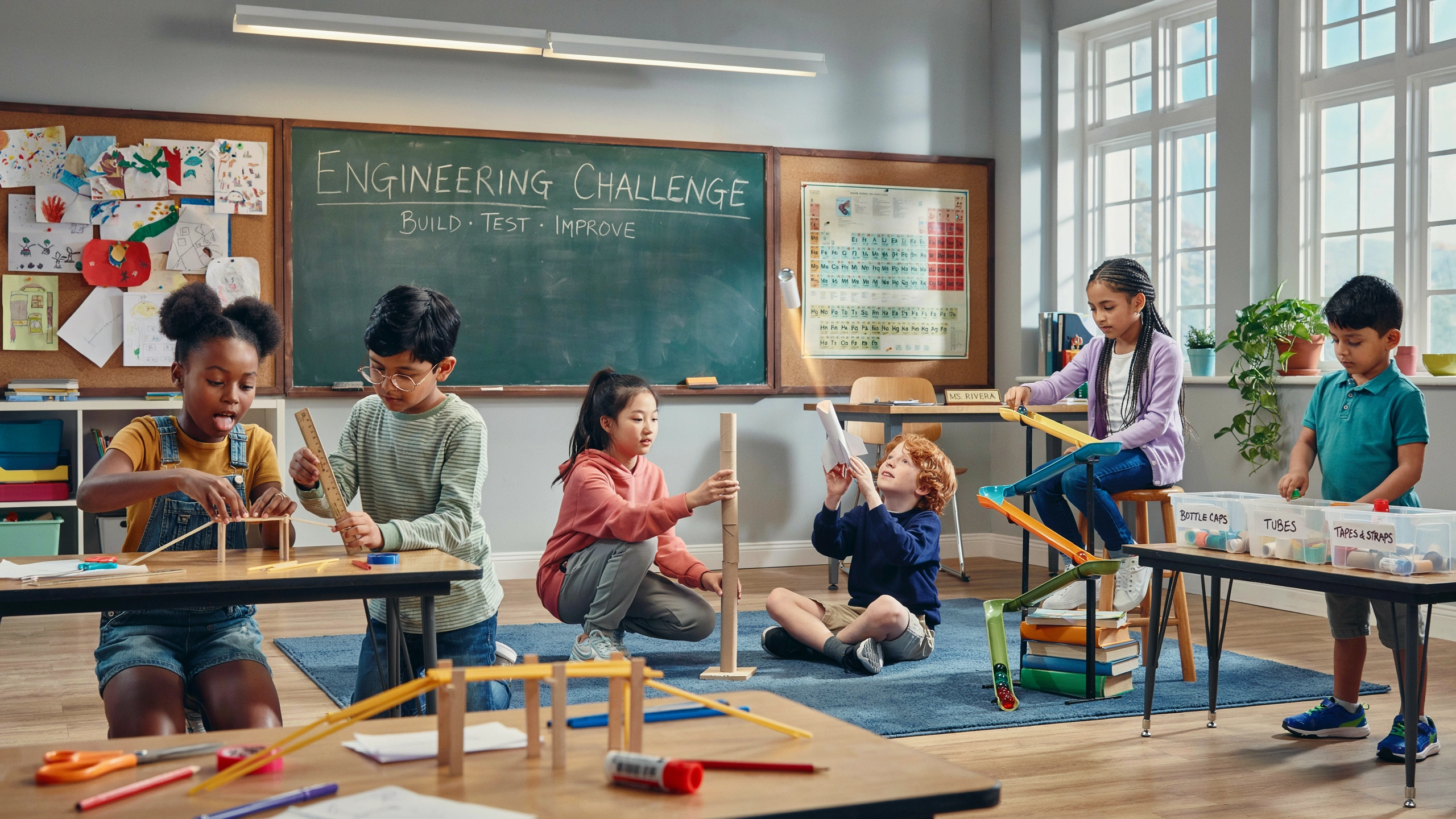
STEM (Science, Technology, Engineering, and Mathematics) helps children develop the skills they need to solve problems, think creatively, and understand how the world works. One of the best ways to introduce STEM is through building challenges that encourage children to design, test, improve, and try again.
Using everyday materials, children can become engineers, inventors, and scientists while learning through hands-on exploration. These activities promote curiosity, teamwork, and resilience, making STEM both educational and enjoyable.
Why STEM Building Challenges Matter
Building challenges teach children that learning comes from experimenting, making mistakes, and improving ideas.
These activities help children:
- Develop critical thinking
- Strengthen engineering and design skills
- Improve creativity and imagination
- Learn persistence through trial and error
- Build confidence by solving problems
- Encourage teamwork and communication
Every challenge becomes an opportunity to apply science and mathematics in a practical way.
Safety Tips Before Building
To ensure a safe experience:
- Supervise young children during all activities.
- Use child-safe scissors and tools.
- Choose clean recycled materials.
- Keep the workspace organized.
- Wear safety glasses if using small construction materials.
A safe environment allows children to focus on creativity and exploration.
What Is the Engineering Design Process?
Introduce children to the simple engineering design process:
- Ask – What problem are we trying to solve?
- Imagine – What ideas could work?
- Plan – Draw or describe your design.
- Create – Build the model.
- Test – See how well it works.
- Improve – Make changes to improve the design.
Professional engineers use this same process to create bridges, robots, buildings, and spacecraft.
Challenge 1: Build the Tallest Tower
Materials
- Paper
- Tape
- Straws
- Cardboard
Instructions
- Build the tallest tower possible.
- It must stand without support.
- Measure the height.
- Improve the design if it falls.
Science Behind It
Children explore balance, stability, and structural engineering.
Challenge 2: Build a Bridge
Materials
- Popsicle sticks
- Cardboard
- Tape
- Books for supports
- Small weights
Instructions
- Build a bridge between two supports.
- Test how much weight it can hold.
- Improve the structure.
Science Behind It
Bridge design depends on force distribution, shape, and material strength.
Challenge 3: Design a Paper Airplane
Materials
- Paper
- Measuring tape
Instructions
- Fold a paper airplane.
- Test how far it flies.
- Modify the design.
- Compare different versions.
Science Behind It
Air resistance, lift, and balance all affect flight performance.
Challenge 4: Create a Marble Run
Materials
- Cardboard tubes
- Tape
- Marbles
Instructions
- Build a track.
- Test the marble.
- Add curves and ramps.
- Improve the design.
Science Behind It
Gravity and friction influence how quickly the marble travels.
Challenge 5: Build the Strongest Boat
Materials
- Aluminum foil
- Water container
- Coins
Instructions
- Design a boat.
- Float it in water.
- Add coins one by one.
- Count how many it holds.
Science Behind It
Boat shape affects buoyancy and weight distribution.
Challenge 6: Construct a Windmill
Materials
- Paper
- Straw
- Pin
- Pencil
Instructions
- Build a paper windmill.
- Test it outdoors or in front of a fan.
- Observe how the blades spin.
Science Behind It
Moving air transfers energy to the blades, creating motion.
Challenge 7: Design a Protective Egg Container
Materials
- Recycled cardboard
- Cotton
- Bubble wrap
- Tape
- Plastic container
Instructions
- Design a container to protect an egg.
- Test it by gently dropping it from a safe height.
- Improve the design after each test.
Science Behind It
Engineers design protective structures by absorbing and distributing impact forces.
Encourage Scientific Thinking
Throughout each challenge, ask children:
- What problem are you trying to solve?
- Why did your design work?
- What could be improved?
- What happened during testing?
- How would an engineer solve this problem?
These questions encourage children to think critically and reflect on their designs.
Skills Children Develop
STEM building activities strengthen:
- Engineering design
- Scientific reasoning
- Critical thinking
- Creativity
- Collaboration
- Communication
- Problem-solving
- Persistence
These skills are valuable not only in science but also in everyday life.
Extend the Learning
Keep the excitement going by:
- Organizing a family STEM challenge day.
- Hosting a classroom engineering competition.
- Building structures with natural materials outdoors.
- Keeping an invention journal.
- Researching famous engineers and inventors.
- Designing solutions to everyday problems.
These extension activities help children see how STEM is used in the real world.
Why STEM Is Important for the Future
STEM skills prepare children for a rapidly changing world. Many careers in healthcare, technology, engineering, environmental science, robotics, architecture, and space exploration require creativity, analytical thinking, and problem-solving abilities.
By introducing STEM through playful building challenges, children gain confidence to explore new ideas, overcome obstacles, and become lifelong learners.
Final Thoughts
Creative STEM building challenges inspire children to imagine, experiment, and innovate. Every tower, bridge, boat, or invention teaches valuable lessons about science, engineering, and perseverance.
The greatest success isn’t building the perfect project—it’s learning from each attempt, asking thoughtful questions, and discovering new solutions. With simple materials and endless imagination, every child can become a young scientist, engineer, and inventor ready to shape the future.