
Introduction
Mathematics is an essential part of everyday life, helping us manage money, tell time, solve problems, and make informed decisions. While many students find math challenging at times, children with dyscalculia experience persistent difficulties in understanding numbers and mathematical concepts that go beyond typical learning struggles.
With effective teaching strategies, appropriate accommodations, and a supportive learning environment, students with dyscalculia can develop mathematical confidence and improve their problem-solving skills. Understanding their unique needs is the first step toward helping them succeed.
What Is Dyscalculia?
Dyscalculia is a specific learning disability that affects a person’s ability to understand numbers, perform calculations, and grasp mathematical concepts. It is sometimes referred to as “math dyslexia,” although it is a distinct condition with its own characteristics.
Students with dyscalculia often have average or above-average intelligence but struggle with numerical reasoning and mathematical processing.
Dyscalculia is a lifelong condition, but early intervention and targeted instruction can significantly improve learning outcomes.
Common Signs of Dyscalculia
The symptoms of dyscalculia vary depending on age and individual learning needs.
Common signs include:
- Difficulty recognizing and comparing numbers.
- Trouble counting accurately.
- Poor understanding of quantity and place value.
- Difficulty memorizing basic math facts.
- Confusion with mathematical symbols.
- Problems estimating time, distance, or measurement.
- Difficulty understanding patterns and sequences.
- Frequent errors when solving calculations.
- Anxiety during mathematics lessons.
Recognizing these signs early allows educators and families to provide timely support.
Challenges in the Classroom
Students with dyscalculia may struggle with many everyday classroom activities, including:
- Learning multiplication tables.
- Solving multi-step word problems.
- Understanding fractions and decimals.
- Measuring length, weight, or volume.
- Reading graphs and charts.
- Keeping numbers aligned correctly.
- Completing timed math tests.
- Applying math concepts to real-life situations.
Without proper support, these challenges may affect confidence and motivation.
Build Strong Number Sense
Developing number sense is one of the most important goals for students with dyscalculia.
Teachers can help by:
- Using number lines.
- Practicing counting activities.
- Comparing quantities with real objects.
- Exploring number patterns.
- Encouraging estimation exercises.
- Connecting numbers to everyday experiences.
A solid understanding of numbers provides the foundation for more advanced mathematics.
Use Hands-On Learning
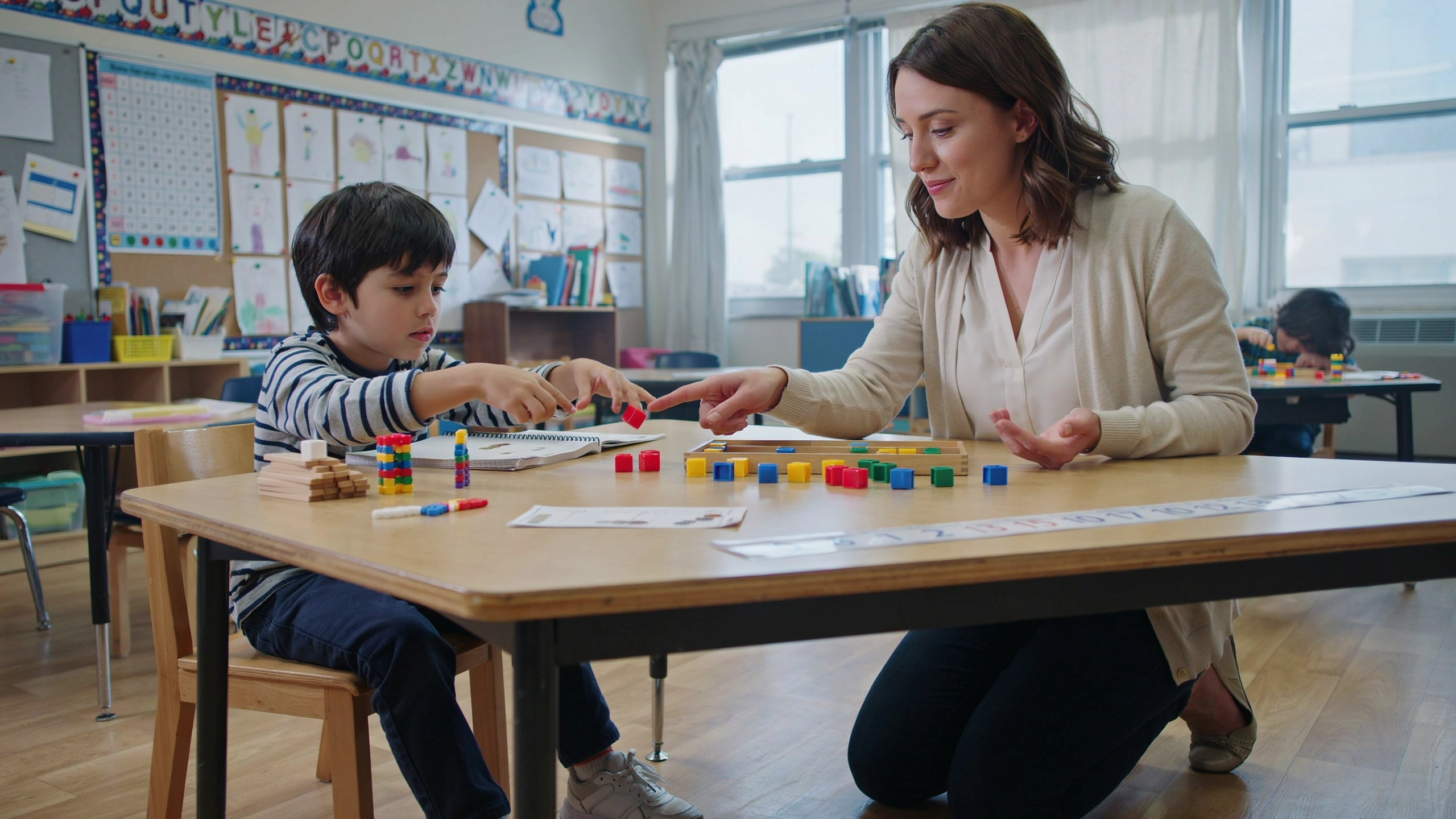
Concrete materials make abstract concepts easier to understand.
Useful manipulatives include:
- Counting blocks.
- Base-ten blocks.
- Counters and beads.
- Dice.
- Fraction circles.
- Measuring cups.
- Play money.
- Clocks with movable hands.
Hands-on learning allows students to see and touch mathematical ideas rather than relying only on symbols.
Teach Step by Step
Students with dyscalculia often benefit from explicit, structured instruction.
Teachers should:
- Introduce one concept at a time.
- Model problem-solving strategies.
- Practice together.
- Provide guided exercises.
- Encourage independent practice.
- Review previously learned skills regularly.
Breaking lessons into small, manageable steps reduces cognitive overload.
Use Visual Supports
Visual representations help students organize mathematical information.
Helpful tools include:
- Color-coded numbers.
- Charts and diagrams.
- Place value mats.
- Graphic organizers.
- Multiplication grids.
- Number bonds.
- Flowcharts for solving problems.
Visual supports improve understanding and memory.
Connect Math to Everyday Life
Students learn more effectively when mathematics feels meaningful.
Teachers and parents can relate math to daily activities such as:
- Shopping and budgeting.
- Cooking and measuring ingredients.
- Reading clocks and schedules.
- Playing board games.
- Sports statistics.
- Gardening and measuring plants.
- Traveling and calculating distances.
Real-life applications make mathematical concepts more engaging and easier to understand.
Reduce Math Anxiety
Many students with dyscalculia develop anxiety because they repeatedly experience failure in mathematics.
Teachers can reduce stress by:
- Encouraging effort rather than perfection.
- Avoiding public comparisons.
- Allowing extra time on assignments and tests.
- Celebrating small improvements.
- Creating a supportive classroom atmosphere.
- Offering frequent encouragement.
Confidence grows when students feel safe to make mistakes and learn from them.
Integrate Assistive Technology
Technology provides valuable support for mathematical learning.
Helpful tools include:
- Calculator apps (when appropriate).
- Interactive math games.
- Digital manipulatives.
- Virtual number lines.
- Educational math software.
- Visual problem-solving apps.
- Adaptive learning platforms that adjust difficulty levels.
Technology complements instruction by providing personalized practice and immediate feedback.
Collaborate with Families
Parents can reinforce mathematical learning at home through simple activities.
Suggestions include:
- Counting household objects.
- Playing card and dice games.
- Practicing money skills.
- Measuring ingredients while cooking.
- Reading calendars together.
- Solving everyday math problems during shopping trips.
Regular communication between teachers and parents helps ensure consistent support.
Assess Progress in Different Ways
Traditional timed tests may not accurately reflect a student’s mathematical understanding.
Alternative assessment methods include:
- Oral explanations.
- Project-based learning.
- Hands-on demonstrations.
- One-on-one problem-solving sessions.
- Math journals.
- Classroom observations.
Using varied assessments allows students to demonstrate their knowledge more effectively.
Looking Beyond Mathematics
Students with dyscalculia often possess strengths in many other areas, including:
- Creativity.
- Storytelling.
- Art and design.
- Music.
- Science.
- Leadership.
- Critical thinking.
Recognizing these talents helps students develop a positive self-image and reminds them that mathematical difficulties do not define their potential.
Conclusion
Supporting students with dyscalculia requires patience, understanding, and thoughtful instructional practices. By building strong number sense, using hands-on learning, providing visual supports, integrating assistive technology, and creating a positive classroom environment, educators can help students overcome mathematical challenges with confidence.
Every child is capable of learning mathematics when given the right support. With encouragement, personalized instruction, and meaningful learning experiences, students with dyscalculia can develop essential math skills and achieve lasting academic success.