
Introduction
Technology has transformed education in remarkable ways, but few innovations have captured the imagination of educators quite like Virtual Reality (VR) and Augmented Reality (AR). These immersive technologies are changing how students explore ideas, solve problems, and experience learning.
Instead of simply reading about historical events, scientific discoveries, or distant places, students can now step inside virtual worlds, interact with 3D models, and participate in realistic simulations. Virtual Reality and Augmented Reality make learning more engaging, memorable, and accessible, opening new possibilities for classrooms around the globe.
As schools continue to adopt digital technologies, VR and AR are becoming powerful tools that support deeper understanding and prepare students for the future.
Understanding Virtual Reality and Augmented Reality
Although Virtual Reality and Augmented Reality are often mentioned together, they serve different purposes.
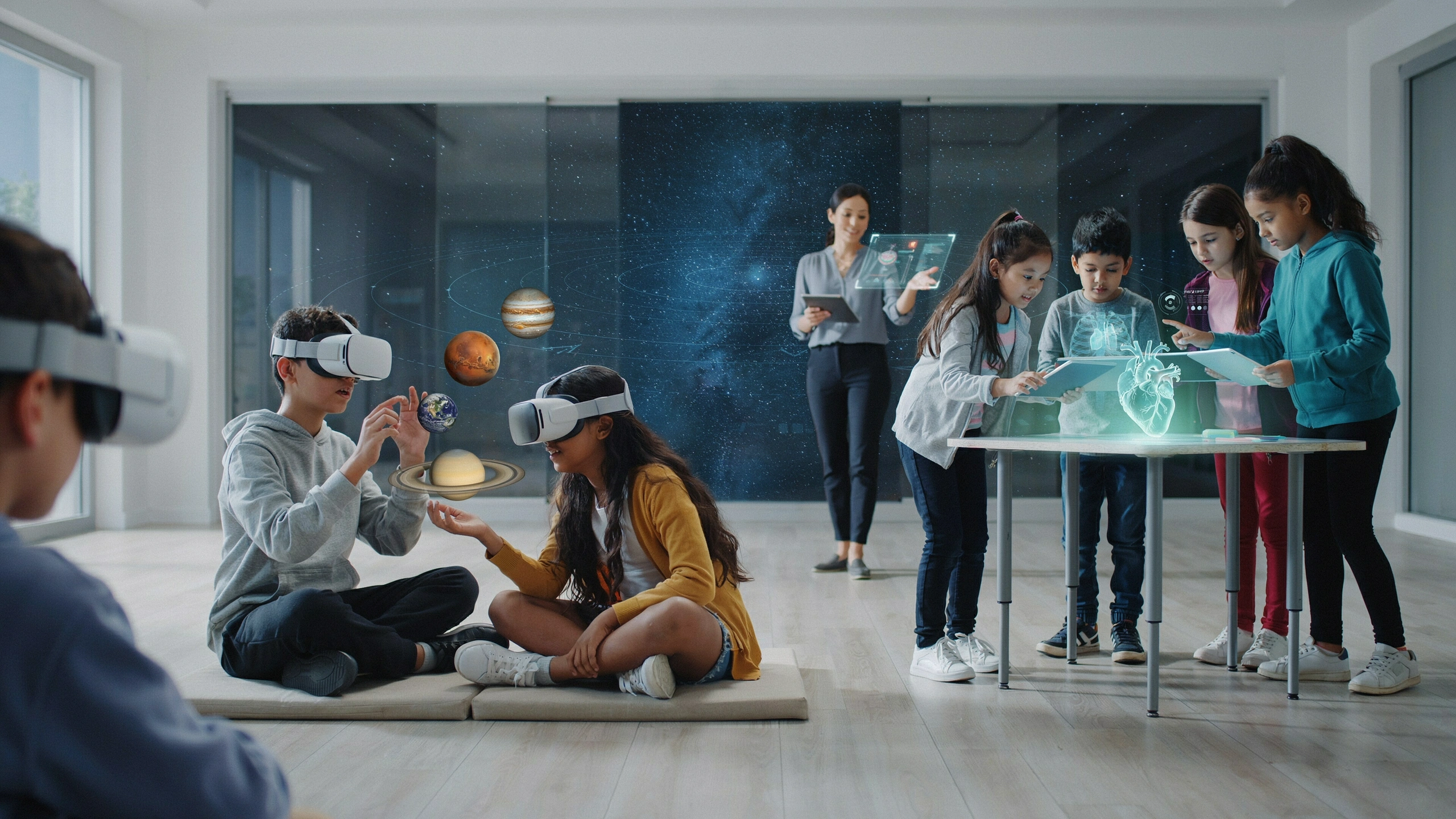
Virtual Reality (VR) creates a completely digital environment that users experience through special headsets. Students can explore virtual museums, travel through the solar system, or perform scientific experiments in a safe and immersive setting.
Augmented Reality (AR) overlays digital images, animations, or information onto the real world using smartphones, tablets, or AR glasses. Instead of replacing reality, AR enhances it by adding interactive digital content to the physical environment.
Both technologies encourage active learning and provide experiences that traditional teaching methods cannot easily offer.
Making Learning More Engaging
One of the greatest advantages of VR and AR is their ability to capture students’ attention.
Rather than passively listening to lectures, learners become active participants in their education.
Students can:
- Walk through ancient civilizations.
- Explore the human body in three dimensions.
- Visit famous landmarks without leaving the classroom.
- Observe volcanic eruptions safely.
- Practice complex scientific procedures.
- Interact with realistic digital models.
These immersive experiences increase curiosity and motivation while making lessons more enjoyable.
Improving Knowledge Retention
Students often remember experiences better than information they simply read or hear.
Immersive learning allows students to visualize abstract concepts, manipulate virtual objects, and actively participate in problem-solving activities.
By engaging multiple senses, VR and AR strengthen memory, improve understanding, and help learners connect theoretical knowledge with practical experiences.
Bringing Science to Life
Science education benefits greatly from immersive technologies.
Students can:
- Explore cells and DNA in 3D.
- Conduct virtual chemistry experiments without safety risks.
- Observe ecosystems from around the world.
- Study astronomy by traveling through space.
- Investigate the inner workings of machines and engines.
These experiences make complex scientific concepts easier to understand and more exciting to explore.
Transforming History and Geography Lessons
History becomes more meaningful when students can virtually visit historical sites or witness important events through immersive simulations.
Learners may explore:
- Ancient Egypt.
- Medieval castles.
- Roman cities.
- World War II landmarks.
- UNESCO World Heritage Sites.
Similarly, geography lessons become interactive as students travel virtually to rainforests, deserts, mountains, oceans, and different countries while studying cultures and environments.
Supporting Medical and Technical Education
VR and AR are especially valuable in professional education.
Medical students can practice surgical procedures in virtual environments before working with real patients.
Engineering students can assemble machinery using interactive 3D models.
Architecture students can walk through building designs before construction begins.
These simulations reduce costs, improve safety, and allow repeated practice without real-world consequences.
Promoting Inclusive Education
Virtual and Augmented Reality can make education more accessible for diverse learners.
These technologies help by:
- Providing visual explanations for complex concepts.
- Offering interactive learning experiences for students with different learning styles.
- Supporting students with physical disabilities through virtual participation.
- Allowing personalized learning pathways based on individual needs.
Inclusive design ensures that more students can benefit from immersive educational experiences.
The Role of Teachers
Although VR and AR provide exciting learning opportunities, teachers remain essential.
Educators guide students by:
- Selecting appropriate learning experiences.
- Connecting virtual activities with curriculum objectives.
- Encouraging reflection and discussion.
- Assessing student understanding.
- Ensuring technology supports meaningful learning rather than entertainment alone.
Technology enhances teaching, but it does not replace the expertise and mentorship of educators.
Challenges of VR and AR in Education
Despite their enormous potential, schools face several challenges when adopting immersive technologies.
High Costs
VR headsets, AR devices, and specialized software can be expensive, making widespread implementation difficult for some schools.
Technical Requirements
Reliable internet access, compatible devices, and technical support are necessary for successful implementation.
Teacher Training
Educators need professional development to effectively integrate immersive technologies into classroom instruction.
Content Availability
Not every subject currently has high-quality VR or AR educational resources, requiring continued investment in content development.
The Future of Immersive Learning
As technology becomes more affordable and accessible, VR and AR will play an increasingly important role in education.
Future developments may include:
- AI-powered virtual learning assistants.
- Fully immersive virtual classrooms.
- Collaborative international learning experiences.
- Personalized VR lessons based on student progress.
- Advanced simulations for vocational and technical training.
- Mixed Reality environments that seamlessly combine physical and digital learning.
These innovations will make education more interactive, collaborative, and learner-centered.
Conclusion
Virtual Reality and Augmented Reality are revolutionizing education by transforming passive learning into immersive experiences. Through interactive simulations, realistic environments, and hands-on exploration, students gain deeper understanding, stronger engagement, and improved knowledge retention.
While challenges such as cost and teacher training remain, the educational benefits of VR and AR continue to grow. As these technologies become more accessible, they will help create classrooms where learning is not only more effective but also more inspiring.
By combining innovation with thoughtful teaching, Virtual Reality and Augmented Reality are helping shape the future of education—one immersive experience at a time.