Water is one of the easiest and most exciting ways to introduce children to science. From floating objects to colorful reactions, simple water experiments encourage curiosity while teaching important scientific concepts. Best of all, most of these activities require only everyday household items.
Whether you’re a parent, teacher, or homeschool educator, these fun water experiments can transform learning into an unforgettable adventure.
Why Water Experiments Are Great for Kids
Children naturally enjoy playing with water. By adding a scientific purpose, water play becomes an engaging educational experience that helps children:
- Develop observation skills
- Learn through hands-on exploration
- Improve problem-solving abilities
- Build critical thinking
- Understand cause-and-effect relationships
- Practice making predictions
Water activities are suitable for preschoolers, elementary-aged children, and even older learners with more advanced challenges.
Safety Tips Before You Begin
To ensure a safe and enjoyable experience:
- Always supervise young children.
- Perform experiments on a waterproof surface or outdoors.
- Clean up spills immediately to prevent slipping.
- Use only child-safe materials.
- Encourage children to wash their hands after each activity.
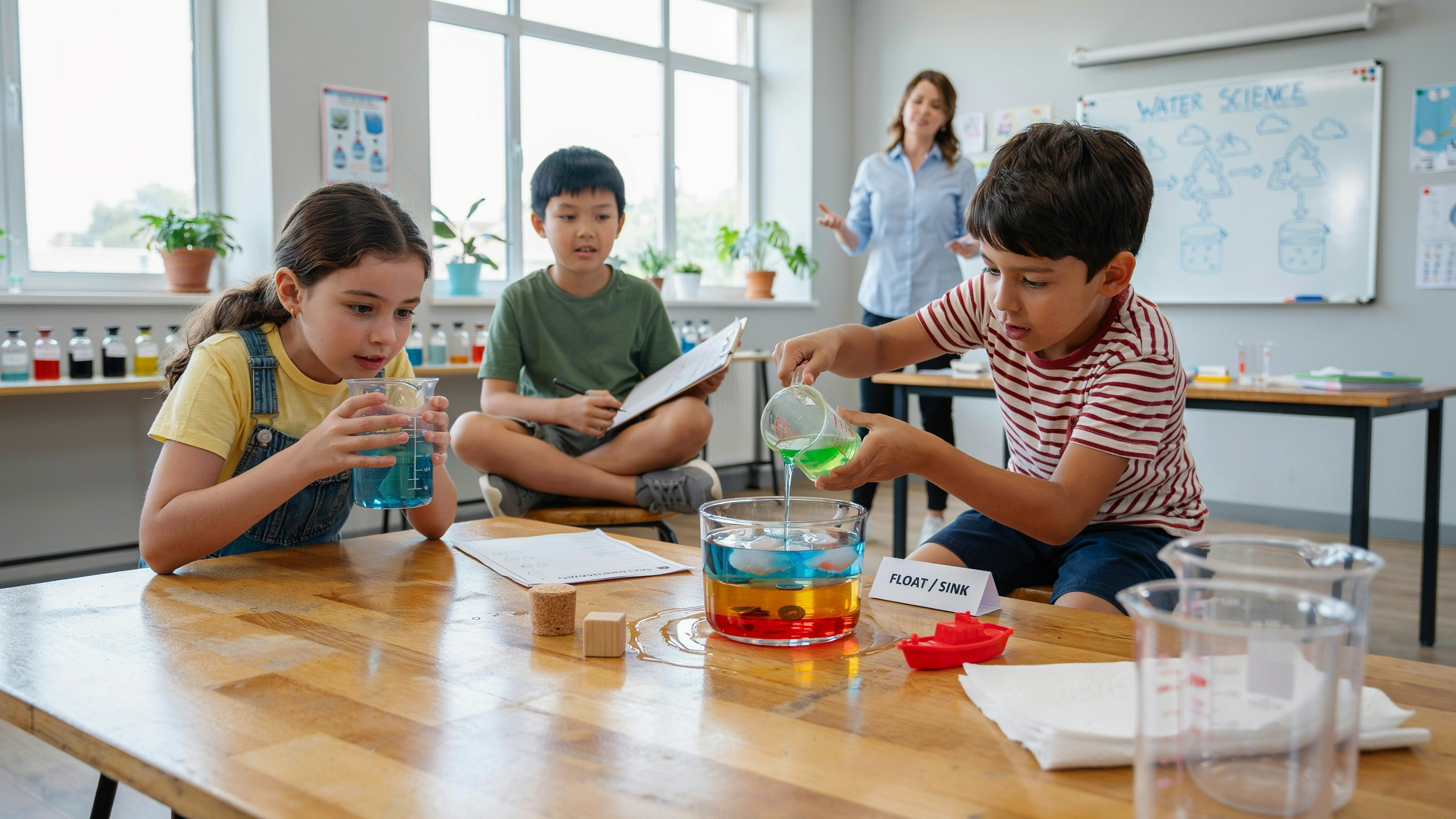
Experiment 1: What Floats and What Sinks?
Materials
- Large bowl or container of water
- Spoon
- Coin
- Plastic toy
- Leaf
- Cork
- Small rock
- Ping-pong ball
Instructions
- Fill the bowl with water.
- Ask your child to predict whether each object will float or sink.
- Place each object into the water one at a time.
- Compare the predictions with the results.
Science Behind It
Objects float or sink depending on their density. Items that are less dense than water float, while denser objects sink.
Experiment 2: Walking Water Rainbow
Materials
- Six clear cups
- Water
- Paper towels
- Red, yellow, and blue food coloring
Instructions
- Fill every other cup halfway with water.
- Add different food coloring to the cups containing water.
- Fold paper towels into strips and place them between each pair of cups.
- Wait several hours.
What Happens?
The colored water slowly travels through the paper towels and mixes in the empty cups, creating new colors.
Science Behind It
Water moves through tiny spaces in the paper towel using capillary action, the same process plants use to transport water from their roots to their leaves.
Experiment 3: Make a Paper Clip Float
Materials
- Bowl of water
- Paper clip
- Tissue paper
Instructions
- Place a small piece of tissue paper on the surface of the water.
- Carefully place the paper clip on top of the tissue.
- Wait until the tissue sinks.
What Happens?
The paper clip remains floating on the surface.
Science Behind It
Water has surface tension, creating a thin “skin” that can support lightweight objects if they are placed carefully.
Experiment 4: Ice Cube Race
Materials
- Several ice cubes
- Warm water
- Salt
- Sugar
- Empty cups
Instructions
- Place one ice cube into each cup.
- Pour warm water over one cube.
- Sprinkle salt on another.
- Sprinkle sugar on another.
- Leave one untouched.
- Observe which cube melts the fastest.
Science Behind It
Different substances affect how quickly ice melts. Salt lowers the freezing point of water, causing ice to melt faster.
Experiment 5: Water Density Layers
Materials
- Honey
- Dish soap
- Water
- Vegetable oil
- Food coloring
- Tall clear glass
Instructions
- Slowly pour honey into the glass.
- Add dish soap.
- Pour in colored water.
- Finish with vegetable oil.
What Happens?
The liquids form separate layers instead of mixing together.
Science Behind It
Each liquid has a different density. The densest liquids settle at the bottom, while lighter liquids remain on top.
Experiment 6: Water Drops on a Coin
Materials
- Coin
- Eyedropper
- Water
Instructions
- Place the coin on a flat surface.
- Add water one drop at a time.
- Count how many drops fit before the water spills over.
Science Behind It
Surface tension allows water to form a dome before overflowing.
Questions to Encourage Scientific Thinking
Ask children questions such as:
- What do you think will happen?
- Why did that happen?
- Which experiment surprised you the most?
- What would change if we used warm water instead of cold water?
- Can you design your own experiment?
These open-ended questions encourage curiosity and deeper understanding.
Skills Children Build
These activities help children develop:
- Observation skills
- Scientific reasoning
- Critical thinking
- Measurement skills
- Patience
- Fine motor coordination
- Communication skills
- Confidence in exploring new ideas
Extend the Learning
After completing the experiments, encourage children to:
- Draw what they observed.
- Record predictions and results in a science journal.
- Repeat experiments using different materials.
- Research why the experiments worked.
- Share their discoveries with family or classmates.
These follow-up activities strengthen both science knowledge and communication skills.
Final Thoughts
Water experiments are an enjoyable and affordable way to introduce children to the wonders of science. Using simple household materials, young learners can explore concepts like density, surface tension, capillary action, and states of matter through hands-on discovery.
The most valuable lesson isn’t just learning scientific facts—it’s developing curiosity, asking thoughtful questions, and enjoying the excitement of exploring how the world works. Every splash, prediction, and observation helps build a lifelong love of science.