
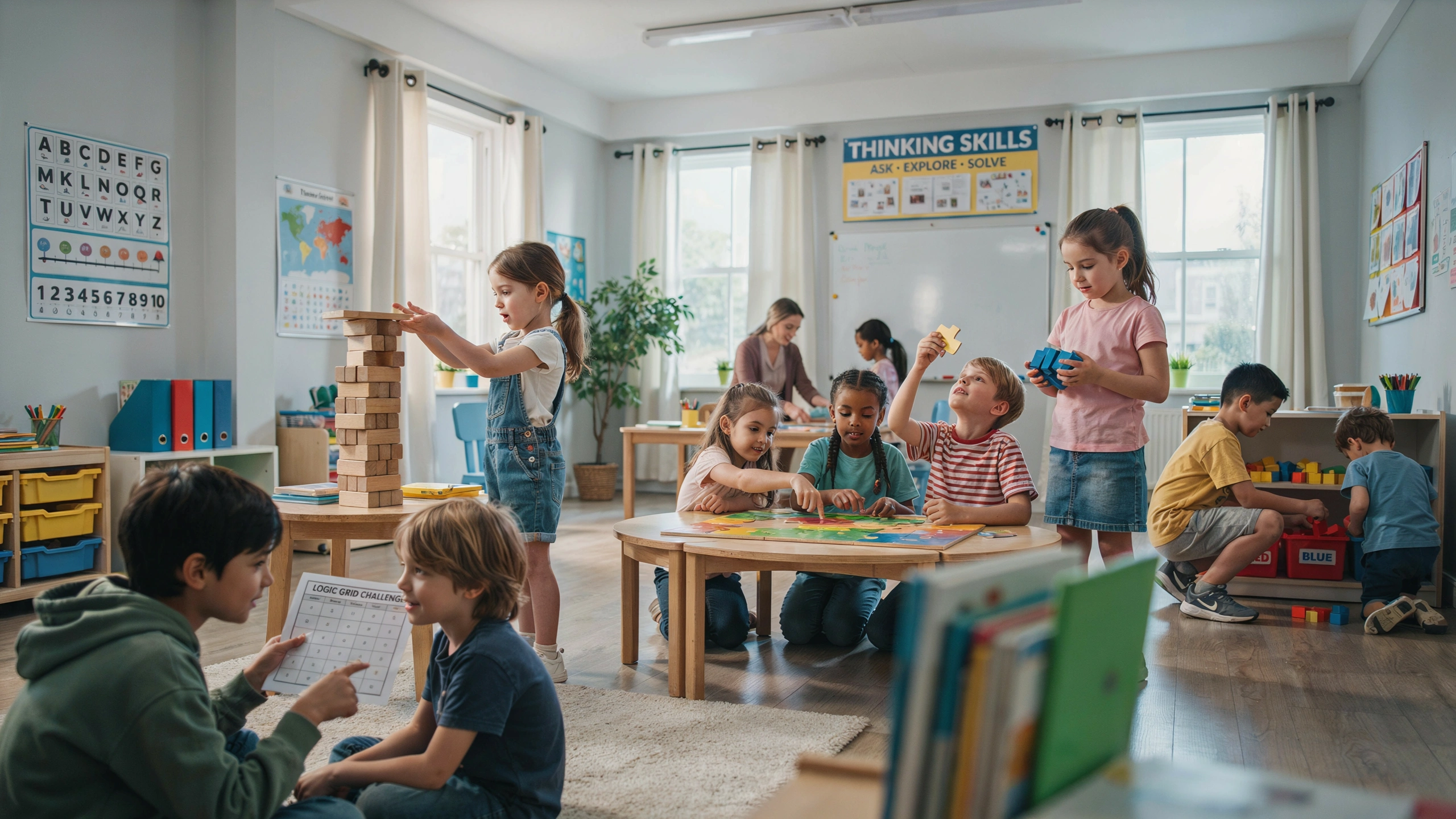
Introduction
Critical thinking is one of the most important skills children can develop. It helps them analyze information, ask thoughtful questions, solve problems, and make informed decisions. Rather than simply memorizing facts, children who think critically learn how to evaluate situations, consider different perspectives, and find creative solutions.
The good news is that critical thinking can be developed through fun, hands-on activities that children genuinely enjoy. Whether your child is a preschooler, elementary student, or older learner, these engaging activities can strengthen reasoning skills while making learning exciting.
1. Ask “Why?” and “How?” Questions
Encourage children to explain their thinking instead of giving one-word answers. Questions like “Why do you think that happened?” or “How would you solve this problem?” help children organize their thoughts and build reasoning skills.
Skills Developed:
- Logical reasoning
- Communication
- Independent thinking
- Confidence
2. Solve Age-Appropriate Riddles
Riddles encourage children to think beyond the obvious answer and consider different possibilities before reaching a conclusion.
Skills Developed:
- Deductive reasoning
- Creativity
- Vocabulary
- Flexible thinking
3. Complete Puzzle Challenges
Jigsaw puzzles, tangrams, and logic puzzles teach children to recognize patterns, analyze pieces, and develop problem-solving strategies.
Skills Developed:
- Spatial reasoning
- Patience
- Planning
- Critical thinking
4. Build with LEGO or Construction Blocks
Ask children to build a bridge, tower, or house using limited materials. They must plan, test ideas, and improve their designs.
Skills Developed:
- Engineering thinking
- Creativity
- Planning
- Experimentation
5. Play “What Would You Do?” Games
Present everyday situations and ask children how they would respond. There may be multiple good answers, encouraging discussion and thoughtful decision-making.
Skills Developed:
- Decision-making
- Empathy
- Reasoning
- Communication
6. Create Treasure Hunts
Hide clues around the house or classroom that require children to solve simple puzzles before moving to the next location.
Skills Developed:
- Logical thinking
- Observation
- Reading comprehension
- Teamwork
7. Compare and Contrast Objects
Choose two animals, foods, or everyday items and ask children to identify similarities and differences.
Skills Developed:
- Classification
- Observation
- Analytical thinking
- Vocabulary
8. Predict Story Endings
Pause while reading a book and ask children what they think will happen next and why.
Skills Developed:
- Prediction
- Inference
- Reading comprehension
- Logical reasoning
9. Conduct Simple Science Experiments
Hands-on experiments encourage children to make predictions, observe results, and explain what happened.
Skills Developed:
- Scientific thinking
- Observation
- Cause and effect
- Curiosity
10. Sorting and Categorizing Activities
Ask children to group objects by color, shape, size, material, or another rule they create themselves.
Skills Developed:
- Organization
- Classification
- Logical thinking
- Creativity
11. Play Memory Games
Matching cards and memory challenges require children to remember information while planning future moves.
Skills Developed:
- Working memory
- Concentration
- Strategy
- Attention
12. Solve Everyday Problems Together
Invite children to help solve real-life situations, such as organizing a room or planning a family picnic.
Skills Developed:
- Practical reasoning
- Decision-making
- Responsibility
- Collaboration
13. Play Strategy Board Games
Games that require planning ahead teach children to evaluate choices before making decisions.
Skills Developed:
- Strategic thinking
- Patience
- Planning
- Adaptability
14. Practice Sequencing Activities
Arrange pictures or events in the correct order to understand logical sequences and cause-and-effect relationships.
Skills Developed:
- Sequencing
- Storytelling
- Logical reasoning
- Organization
15. Explore Coding Games
Simple coding activities introduce children to algorithms, patterns, and logical problem-solving in a fun way.
Skills Developed:
- Computational thinking
- Precision
- Sequencing
- Creativity
16. Encourage Open-Ended Art Projects
Instead of following instructions exactly, let children decide how to complete an art project using their own ideas.
Skills Developed:
- Creative thinking
- Decision-making
- Innovation
- Self-expression
17. Debate Friendly Topics
Ask simple questions such as, “Which season is the best?” and encourage children to support their opinions with reasons.
Skills Developed:
- Argument building
- Listening
- Communication
- Critical evaluation
18. Spot Patterns in Nature
Take a nature walk and encourage children to identify repeating shapes, colors, or behaviors in plants and animals.
Skills Developed:
- Observation
- Pattern recognition
- Curiosity
- Scientific thinking
19. Play “Guess the Rule”
Create a sequence of numbers, colors, or shapes and challenge children to discover the hidden pattern.
Skills Developed:
- Logical analysis
- Deduction
- Pattern recognition
- Flexible thinking
20. Reflect on Mistakes
After completing an activity, ask children what worked well, what didn’t, and what they would do differently next time.
Skills Developed:
- Self-reflection
- Problem-solving
- Growth mindset
- Decision-making
Tips for Parents and Teachers
To encourage critical thinking every day:
- Ask open-ended questions instead of yes-or-no questions.
- Allow children time to think before answering.
- Encourage multiple solutions to the same problem.
- Praise the thinking process rather than just the correct answer.
- Turn everyday situations into learning opportunities.
- Let children make age-appropriate decisions independently.
Conclusion
Critical thinking is not a skill that develops overnight—it grows through daily practice, curiosity, and meaningful experiences. By introducing engaging activities such as puzzles, experiments, discussions, and strategy games, parents and teachers can help children become confident thinkers who enjoy solving problems and exploring new ideas. These skills will support success not only in school but throughout every stage of life.