
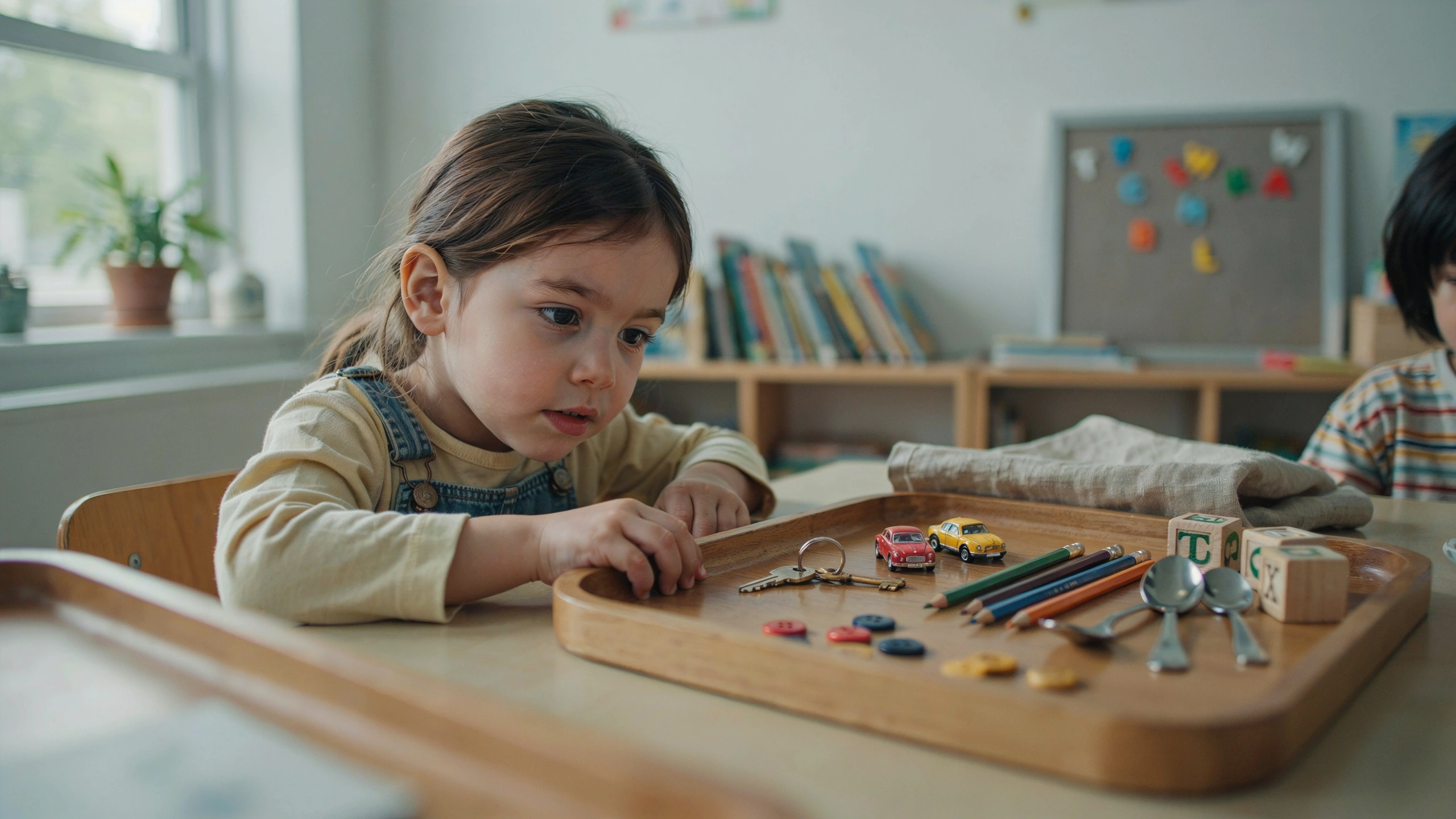
Memory tray games have been a favorite educational activity for generations, and for good reason. They are simple to prepare, require only everyday household items, and provide powerful benefits for children’s cognitive development. By observing a collection of objects and recalling them from memory, children strengthen essential skills such as attention, concentration, observation, and visual recall.
Whether used at home, in preschool classrooms, or during homeschool lessons, memory tray games offer an engaging way to help children build the mental skills they need for lifelong learning.
In this article, you’ll discover how memory tray games work, why they are so effective, and several creative variations to keep children challenged and excited.
What Is a Memory Tray Game?
A memory tray game involves placing a variety of objects on a tray or table for children to observe. After a short viewing period, the objects are covered or removed, and children are asked to remember as many items as possible.
The activity can be adapted in countless ways, making it suitable for children of different ages and ability levels.
Why Memory Tray Games Are Important
Memory tray activities strengthen several key cognitive abilities, including:
- Visual memory
- Working memory
- Sustained attention
- Observation skills
- Concentration
- Vocabulary development
- Logical thinking
- Confidence
These skills are essential for reading, writing, mathematics, and everyday problem-solving.
Materials You’ll Need
One of the greatest advantages of memory tray games is that they require very little preparation.
You can use items such as:
- Spoon
- Key
- Toy car
- Button
- Coin
- Pencil
- Block
- Leaf
- Small ball
- Eraser
- Cup
- Crayon
Choose familiar objects that are safe and easy for children to recognize.
How to Play the Classic Memory Tray Game
- Arrange 8–15 objects on a tray.
- Give children 30–60 seconds to study the items carefully.
- Cover the tray with a cloth or remove it from sight.
- Ask children to name, draw, or write every object they remember.
- Reveal the tray and compare their answers.
This simple activity provides an excellent workout for the brain.
1. What’s Missing?
After children study the tray, secretly remove one object.
Ask them:
“Which item is missing?”
As children improve, remove two or three objects for a greater challenge.
2. Order Recall Challenge
Arrange the objects in a specific order.
After hiding the tray, ask children to place the objects back in exactly the same sequence.
This strengthens sequential memory and attention to detail.
3. Color Memory Tray
Fill the tray with colorful objects.
After observation, ask questions such as:
- Which object was blue?
- How many red items were there?
- Which color appeared most often?
This combines memory practice with color recognition.
4. Category Memory Game
Use objects from a single category, such as:
- Kitchen utensils
- School supplies
- Fruits
- Animals
- Toys
After recalling the items, encourage children to discuss what the objects have in common.
This builds vocabulary and classification skills.
5. Nature Memory Tray
Collect natural treasures during an outdoor walk.
Examples include:
- Leaves
- Pinecones
- Flowers
- Pebbles
- Feathers
- Acorns
Display the collection on a tray before beginning the memory challenge.
Nature themes make learning more engaging and encourage scientific observation.
6. Sound Memory Variation
Instead of showing the objects, hide them in a bag.
Shake or tap each item to create a sound.
Children remember the sounds and identify the objects in the correct order.
This activity develops auditory memory.
7. Mystery Bag Recall
Place several objects inside a cloth bag.
Children feel each object without looking.
Afterward, they describe or name every item they remember.
This sensory version develops tactile memory and descriptive language.
8. Picture Memory Tray
Replace real objects with photographs or picture cards.
Possible themes include:
- Farm animals
- Transportation
- Healthy foods
- Community helpers
- Alphabet letters
Picture trays are especially useful in classrooms.
Ways to Increase the Difficulty
As children’s memory improves, make the activity more challenging by:
- Increasing the number of objects.
- Shortening observation time.
- Using similar-looking items.
- Asking children to recall object positions.
- Combining colors, shapes, and categories.
- Asking children to describe each object in detail.
Gradual challenges help maintain interest while strengthening memory.
Tips for Parents and Teachers
For the best learning experience:
- Keep sessions between 10 and 15 minutes.
- Encourage children to look carefully before the tray is covered.
- Praise observation rather than perfect recall.
- Allow children to create trays for one another.
- Rotate themes regularly to maintain excitement.
- Discuss each object after revealing the tray.
Making the activity interactive encourages deeper learning.
Skills Developed Through Memory Tray Games
These classic activities strengthen many important developmental skills, including:
- Visual discrimination
- Working memory
- Concentration
- Attention to detail
- Vocabulary
- Critical thinking
- Problem-solving
- School readiness
Regular memory practice supports children’s success across multiple subjects.
Final Thoughts
Memory tray games remain one of the most effective and affordable activities for developing children’s cognitive skills. By encouraging careful observation, strong recall, and thoughtful discussion, these simple games help children improve memory, concentration, and attention in a fun and meaningful way.
Whether you’re using household objects, classroom materials, or treasures from nature, memory tray games can easily become part of your daily learning routine. Just a few minutes of practice each day can make a lasting difference in a child’s confidence and cognitive development.